
You hit a $2,000 floating profit during the New York session, hold the trade through high-impact news, watch the profit pull back to +$300, and close out. You made $300 in cold hard cash—yet your dashboard suddenly flashes red with a Rule Breach Notice.
What happened? You fell victim to an intraday equity trailing drawdown.
Trailing drawdown is the single biggest reason retail traders breach evaluation and funded accounts at firms like Apex Trader Funding, Funding Pips, and E8. Understanding how prop firms calculate drawdown—and how trailing mechanics differ from static rules—is the difference between securing payouts and burning evaluation fees.

What Is Static Drawdown? (Balance / Fixed Drawdown)
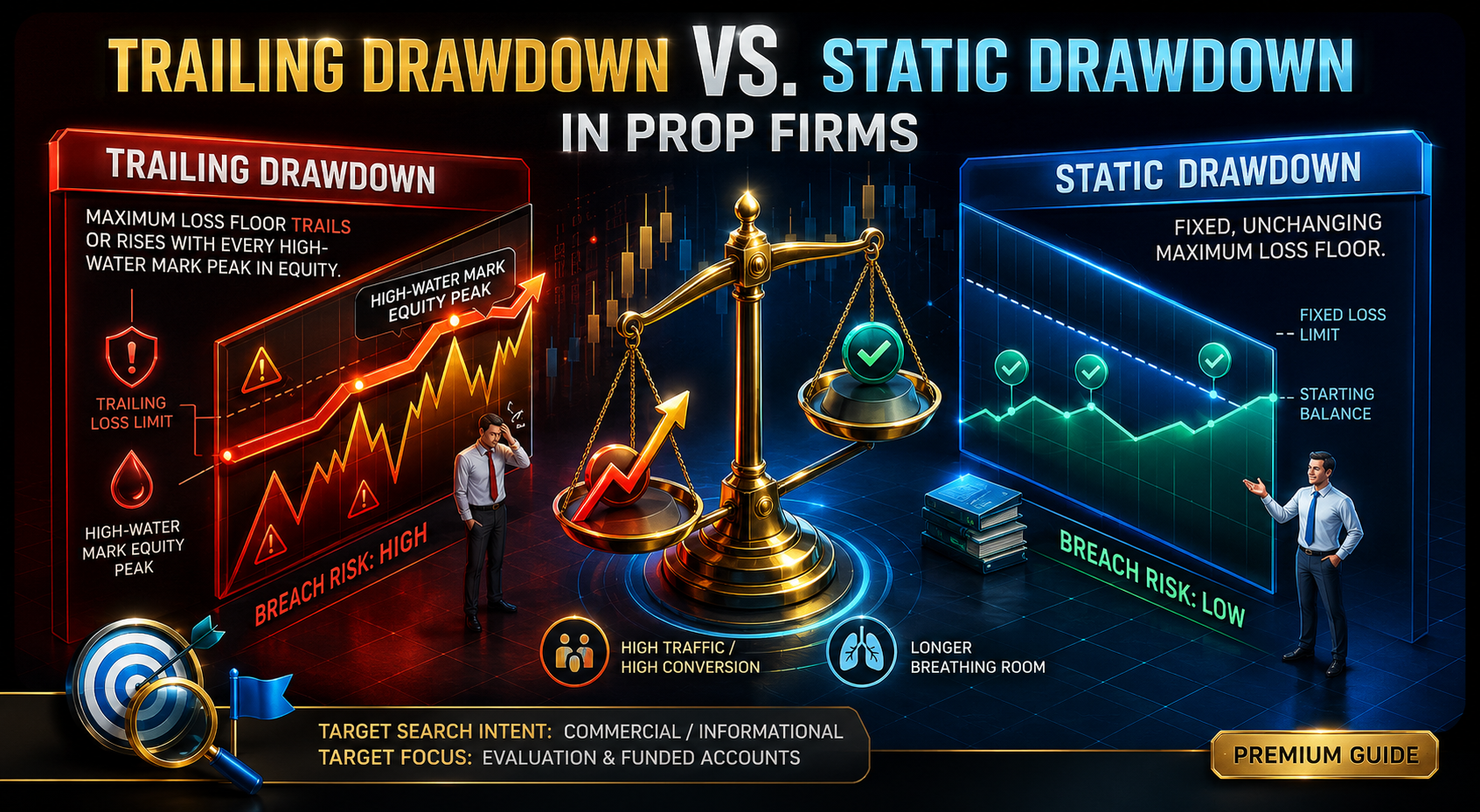
Static drawdown (also known as fixed or static balance drawdown) sets a permanent, unmoving floor based on your starting account balance.
If you purchase a $100,000 account with a 5% static drawdown limit, your absolute account minimum is $95,000.
- Starting Balance: $100,000
- Maximum Loss Threshold: $95,000 (Fixed permanently)
- If your account grows to $110,000: Your loss threshold remains at $95,000.
Key Advantage: Static drawdown gives you more breathing room as your account grows. Every dollar of profit you lock in expands your buffer above the breach level.
What Is Trailing Drawdown?
Unlike static drawdown, trailing drawdown moves upward as your account balance or floating equity increases. It “trails” your peak account value (your High-Water Mark) at a set distance (typically 4% to 6%).
However, prop firms implement trailing drawdown in two distinct ways:
1. Closed Balance Trailing Drawdown
The drawdown limit only recalculates at the end of the trading day or when you close trades.
- If you hold an open trade with $3,000 in floating profit, but close it at +$1,000, your new high-water mark increases by $1,000.
- Your minimum balance line ratchets up by $1,000.
2. Intraday Equity Trailing Drawdown (The Silent Killer)
The drawdown threshold recalculates in real time based on unrealized high-water marks.
- If an open trade hits +$3,000 in floating profit, your drawdown threshold instantly ratchets up by $3,000 while the trade is still running.
- If price reverses and you close the trade at breakeven ($0 net profit), your drawdown line does not move back down. You just lost $3,000 of your drawdown buffer without making a single cent.
Step-by-Step Scenario: How Intraday Trailing Destroys Accounts
Let’s look at how two traders perform on a $100,000 account with a $5,000 (5%) drawdown limit:
| Scenario Event | Trader A: Static Drawdown ($95k Fixed Floor) | Trader B: Intraday Trailing Drawdown ($5k Trailing) |
| Start | Floor = $95,000 | Floor = $95,000 |
| Trade 1: Reaches +$4,000 floating profit | Floor stays $95,000 | Floor ratchets up to $99,000 ($104k peak minus $5k) |
| Market reverses: Closed at breakeven ($100k balance) | Balance = $100,000 Buffer = $5,000 | Balance = $100,000 Buffer remaining = $1,000 |
| Trade 2: Takes a normal -$1,500 loss | Balance = $98,500 Account Safe | Balance = $98,500 ACCOUNT BREACHED (Below $99k floor) |
Trader B was breached despite never taking a net loss exceeding $1,500 on closed trades.
Direct Comparison: Trailing vs. Static Drawdown
| Feature | Static / Fixed Drawdown | Closed Balance Trailing | Intraday Equity Trailing |
| Breach Threshold | Fixed permanently at starting level | Trails closed balance peak | Trails unrealized floating equity peak |
| Ratcheting Effect | None | Moves up when trades close in profit | Moves up in real time on open profits |
| Locks in at Starting Balance? | N/A | Usually stops trailing once balance = initial balance + fee | Varies by firm |
| Best Trading Style | Swing trading, news trading, holding winners | Trend following, breakout trading | Scalping, fixed TP/SL targets |
| Breach Risk Level | Low | Moderate | High |
3 Essential Rules to Pass Trailing Drawdown Challenges
If you are trading with a firm that utilizes trailing drawdown, standard risk management rules will get you failed. Adapt your execution with these three adjustments:
- Never Let Unrealized Profits Reversely Evaporate: Use hard Take-Profit (TP) levels and scale out of positions aggressively. Letting a trade float into major profits and pull back eats directly into your loss allowance.
- Beware of News Volatility: Spikes in floating equity followed by rapid pullbacks will raise your trailing floor and leave you stranded at the top.
- Use Quantitative Execution Indicators: Avoid manual, emotional trade management. Ensure your entry and exit points rely on structured liquidity indicators that lock in profits automatically.
Get the Edge: Looking for tested technical tools to keep your positions precise? Download our Top 20 Free Trading Indicators to optimize your entry and exit timing.
Passing Your Next Prop Firm Evaluation
Understanding trailing mechanics is half the battle—the other half is running a strategy designed specifically to operate within strict prop firm risk envelopes.
Whether you are navigating static, balance-trailing, or equity-trailing accounts, having an institutional rulebook prevents unforced errors.
- Master the Mechanics: Learn how to engineer your position sizing for prop rules with the FB500 Funding Edge Strategy Guide.
- Ready for Capital? Explore elite capital allocation options and apply for funding on Forex Broker 500.

No responses yet