
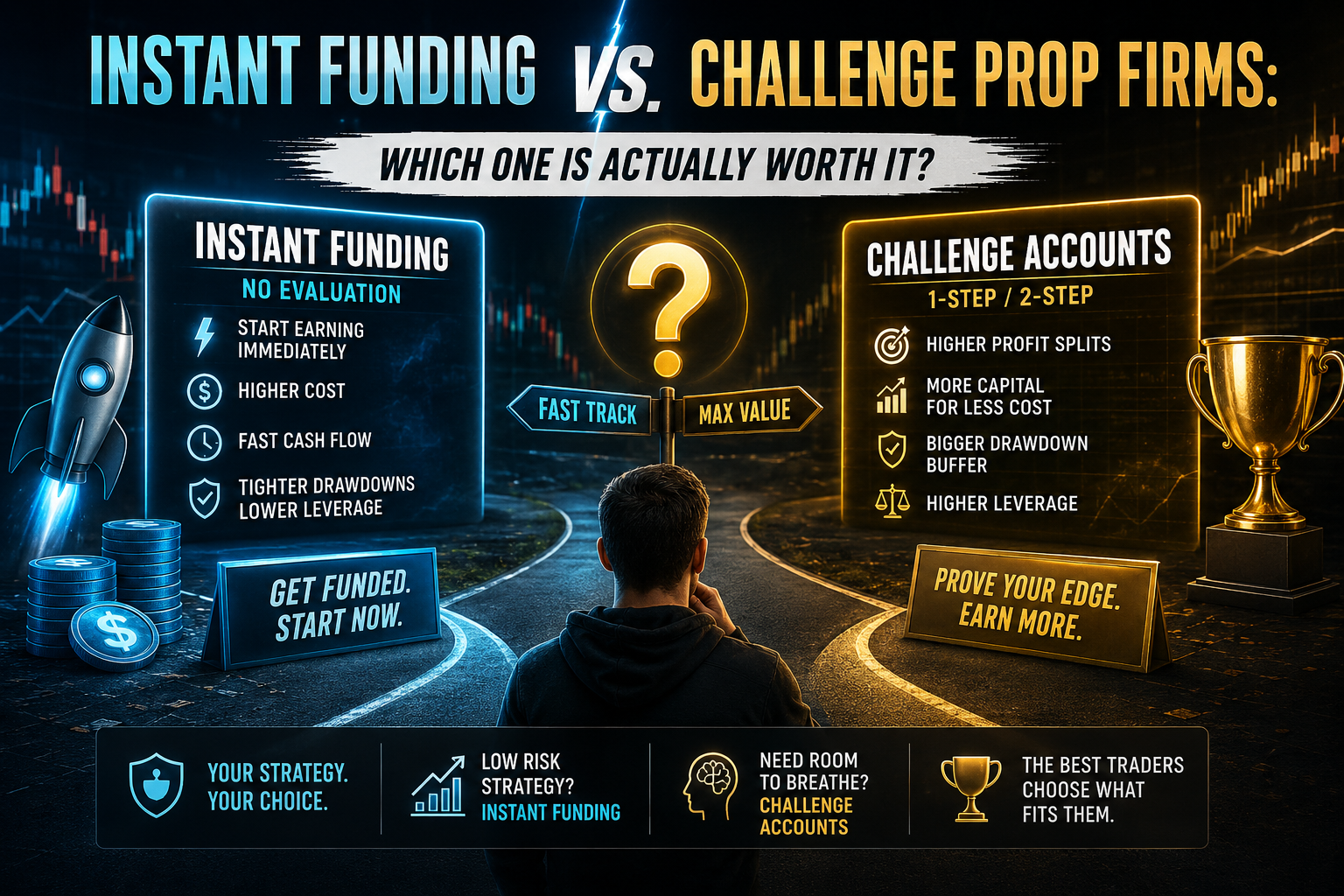
If you’ve been looking to scale your trading capital, you’ve likely faced the central dilemma of modern prop trading: Should you buy an instant funding account or tackle an evaluation challenge?
The shift toward instant funding (no-evaluation) accounts has exploded recently. Traders are increasingly looking to skip the strict profit targets, time pressures, and multi-stage phases of traditional 1-step or 2-step evaluation models.
However, instant gratification comes with trade-offs. Higher upfront costs, lower leverage, and tighter drawdown limits mean instant funding isn’t a magic bullet for every trader. Below, we break down the exact math, profit-split dynamics, and cost-per-capital ratios so you can decide which path fits your trading style.
What Is the Core Difference?

At a high level, the distinction comes down to time vs. upfront cost:
- Challenge / Evaluation Accounts (1-Step or 2-Step): You pay a relatively small upfront fee, but you must trade on a demo account and reach a specific profit target (usually 8–10% in Phase 1 and 5% in Phase 2) while adhering to strict daily and maximum drawdown limits. Once passed, you receive a funded account.
- Instant Funding Accounts (No Evaluation): You pay a higher fee upfront to skip the demo evaluation completely. You get access to live profit-split conditions from day one, but account sizes or drawdown buffers relative to your fee are significantly tighter.
Side-by-Side Breakdown: Instant Funding vs. Challenge Accounts
| Feature | Instant Funding (No Evaluation) | 1-Step / 2-Step Challenge |
| Evaluation Phase | None — Start earning immediately | 1 or 2 phases (demo account) |
| Upfront Cost | Higher ($150–$500+ for $10K–$25K) | Lower ($100–$500 for $50K–$100K) |
| Max Profit Split | 50% – 80% (scales up over time) | 80% – 90% from the first payout |
| Max Drawdown | Usually 3% – 6% (static or trailing) | Usually 8% – 12% |
| Leverage | Lower (typically 1:10 to 1:30) | Higher (typically 1:30 to 1:100) |
| First Payout Schedule | On demand or 14–30 days | Usually 14–30 days after passing |
Analyzing the Cost-per-Capital Ratio
When asking “is instant funding worth it?”, the key metric to analyze is your cost-per-capital ratio and your effective drawdown buffer.
When you buy a “$100,000 Challenge Account” for $500, with a 10% maximum drawdown ($10,000), you are essentially paying $500 to trade $10,000 of real risk capital.
By contrast, an instant funded account offering “$25,000 capital” with a 5% maximum drawdown gives you $1,250 in actual risk cushion. If that account costs $250 upfront, you are paying a much higher percentage of your drawdown limit as a fee.
Key Takeaway: Instant funding gives you immediate access to real profit payouts, but your actual risk allowance relative to your fee is smaller. If you have a high win-rate strategy with tight risk parameters, instant funding can yield immediate returns. If you rely on wider stop losses or higher leverage, a 2-step challenge offers significantly more breathing room.
When to Choose Instant Funding
An instant funding account is ideal if:
- You have a proven, low-drawdown strategy: You consistently make 2–5% monthly with tight risk management and don’t need massive leverage.
- You want to eliminate evaluation anxiety: You struggle with the psychological pressure of meeting fixed profit targets within specific timeframe rules.
- You want fast cash flow: You prefer withdrawing real profits right away rather than spending weeks or months navigating evaluation phases.
If you’re hunting for the cheapest instant funded trading account, pay close attention to minimum payout thresholds and scaling plans rather than just the sticker price.
When to Choose a 1-Step or 2-Step Challenge
A traditional challenge account is ideal if:
- You want maximum leverage & drawdown room: You need higher leverage to execute your strategy effectively.
- You want the best profit-split ratio: You want 80–90% payout splits from day one of being funded.
- You want maximum capital per dollar spent: You want to control $100K–$200K in account size for a fraction of the cost of instant funding.
If you decide to go the evaluation route, having a disciplined execution plan is critical to avoiding rule violations during Phase 1. Check out our comprehensive guide on the Prop Firm Passing Strategy (FB500 Funding Edge) to streamline your evaluation process and pass consistently.
Tools & Next Steps for Prop Traders
Whether you choose no evaluation prop firm vs 2 step models, successful prop trading relies heavily on technical execution and strict risk management.
- Enhance Your Technicals: Upgrade your chart setups before taking on any account by grabbing our Top 20 Free Trading Indicators Download.
- Explore Top-Rated Firms: Browse through our curated reviews and comparison tables for the top prop funding accounts directly on the ForexBroker500 Home Page.

No responses yet