
Introduction
If you’ve been struggling to understand why price moves the way it does, you’re not alone.
Most retail traders focus on indicators.
Smart traders focus on liquidity and imbalance.
These two concepts are at the core of Smart Money Concepts (SMC) — the idea that institutions (banks, hedge funds) move the market by targeting liquidity and filling inefficiencies.
Once you understand this, charts stop looking random… and start making sense.
What is Liquidity in Trading?

Liquidity refers to areas where orders are concentrated.
These are typically:
- Equal highs (buy-side liquidity)
- Equal lows (sell-side liquidity)
- Trendline touches
- Support and resistance zones
Institutions don’t chase price — they hunt liquidity.
They need large volumes to enter positions, and that volume comes from:
👉 Retail traders’ stop losses
👉 Breakout traders’ entries
What is Imbalance (Fair Value Gap)?

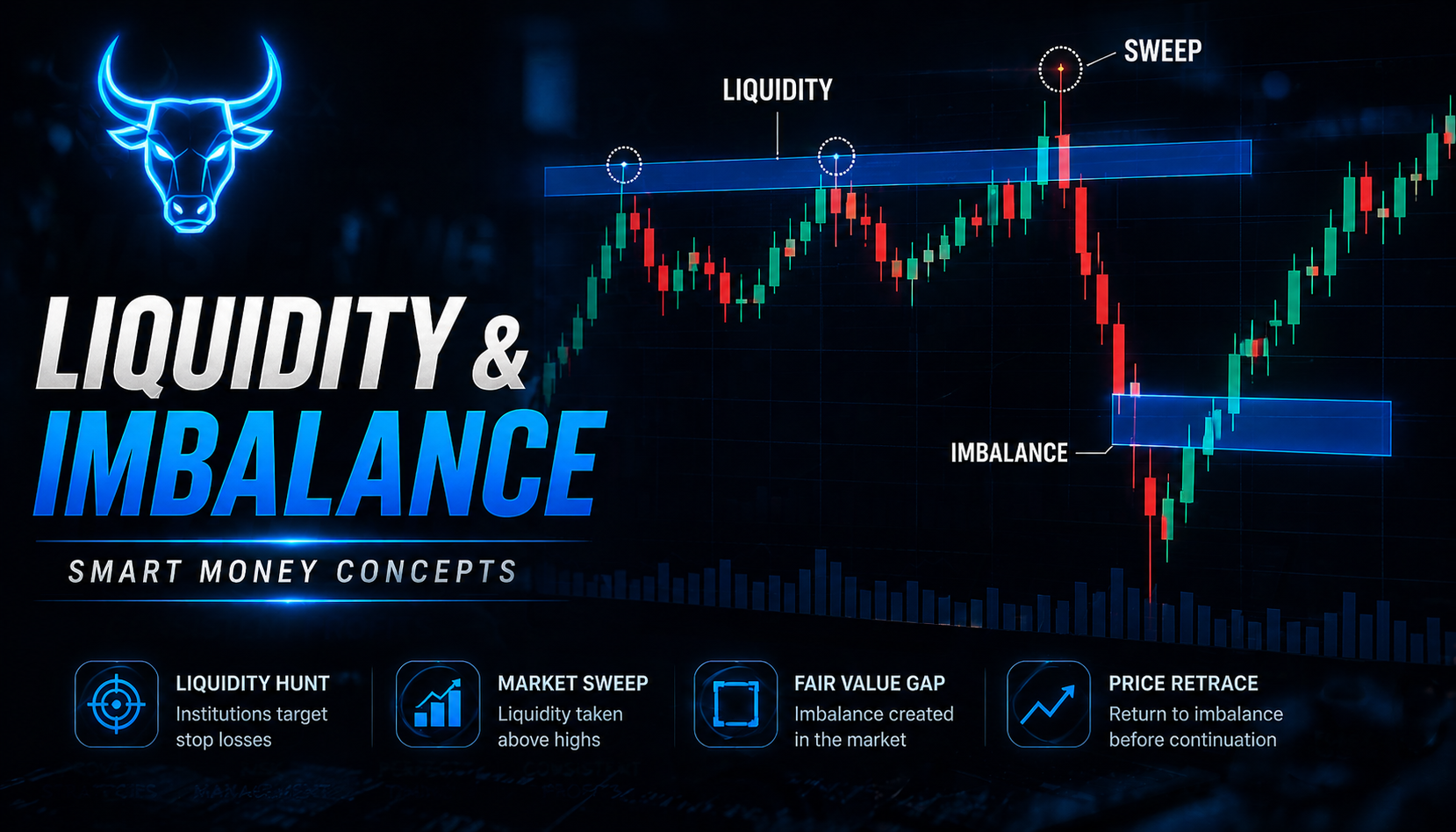
An imbalance (also called a Fair Value Gap) is a price inefficiency created when the market moves too fast in one direction.
This usually appears as a gap between candles.
Key idea:
Price tends to return to these zones to “rebalance” before continuing.
The Relationship Between Liquidity & Imbalance

Here’s how the market typically moves:
- Price targets liquidity (highs or lows)
- Liquidity gets swept (stop losses triggered)
- Strong move creates imbalance
- Price retraces into imbalance
- Trend continues
👉 This is the foundation of SMC trading.
How to Trade Liquidity Sweeps

7
Step-by-step:
- Identify equal highs or lows
- Wait for price to sweep that level
- Look for rejection (strong candle, wick)
- Enter in the opposite direction
This is where most retail traders get trapped — and smart traders profit.
How to Trade Imbalance (Fair Value Gaps)


Strategy:
- Identify a strong impulsive move
- Mark the imbalance zone
- Wait for price to retrace into it
- Enter with confirmation
👉 Imbalance acts like a magnet for price.
Best Timeframes for SMC Trading
- Higher Timeframes (H1, H4, Daily) → Identify liquidity zones
- Lower Timeframes (M5, M15) → Refine entries
This multi-timeframe approach gives you precision + context.
Risk Management Rules
Let’s keep it real — SMC without risk management is dangerous.
- Risk only 1–2% per trade
- Don’t enter without confirmation
- Avoid trading during major news spikes
- Always use stop loss
Even the best setup fails without discipline.
Common Mistakes Traders Make
- Entering before liquidity is taken
- Trading every imbalance (not all are valid)
- Ignoring higher timeframe structure
- Overcomplicating the concept
- Chasing moves
👉 Simplicity wins in SMC trading.
Tools That Help You Trade Better
To execute these strategies properly, you need:
- Lot size calculator
- Risk management tools
- Market structure tracking
- Session timing awareness
🧰 Use the Trader Toolkit App:
Final Thoughts
Liquidity and imbalance are not just strategies — they are how the market actually moves.
If you learn to:
- Identify where liquidity sits
- Wait for sweeps
- Enter on imbalance
You move from guessing… to understanding.
Take the Next Step
Ready to trade like institutions?
Learn how to access funding, improve your strategy, and scale your trading — without risking your own capital.
Disclaimer
Forex Broker 500 is an educational platform and not a broker. We do not accept deposits or execute trades. We may partner with proprietary trading firms and affiliate providers. Trading involves risk, and past performance does not guarantee future results.

No responses yet