
Introduction
If you want to stop guessing in forex trading and start understanding what the market is actually doing, you need to learn market structure.
Market structure is the foundation of price action. It tells you:
- Whether the market is trending or ranging
- When a trend is changing
- Where high-probability trades are likely to happen
In simple terms, market structure shows you the story behind price movement.
What Is Market Structure in Trading?
Market structure refers to the way price moves on a chart through:
- Highs
- Lows
- Trends
👉 By analyzing these movements, traders can determine direction and make better decisions.
The Three Types of Market Structure
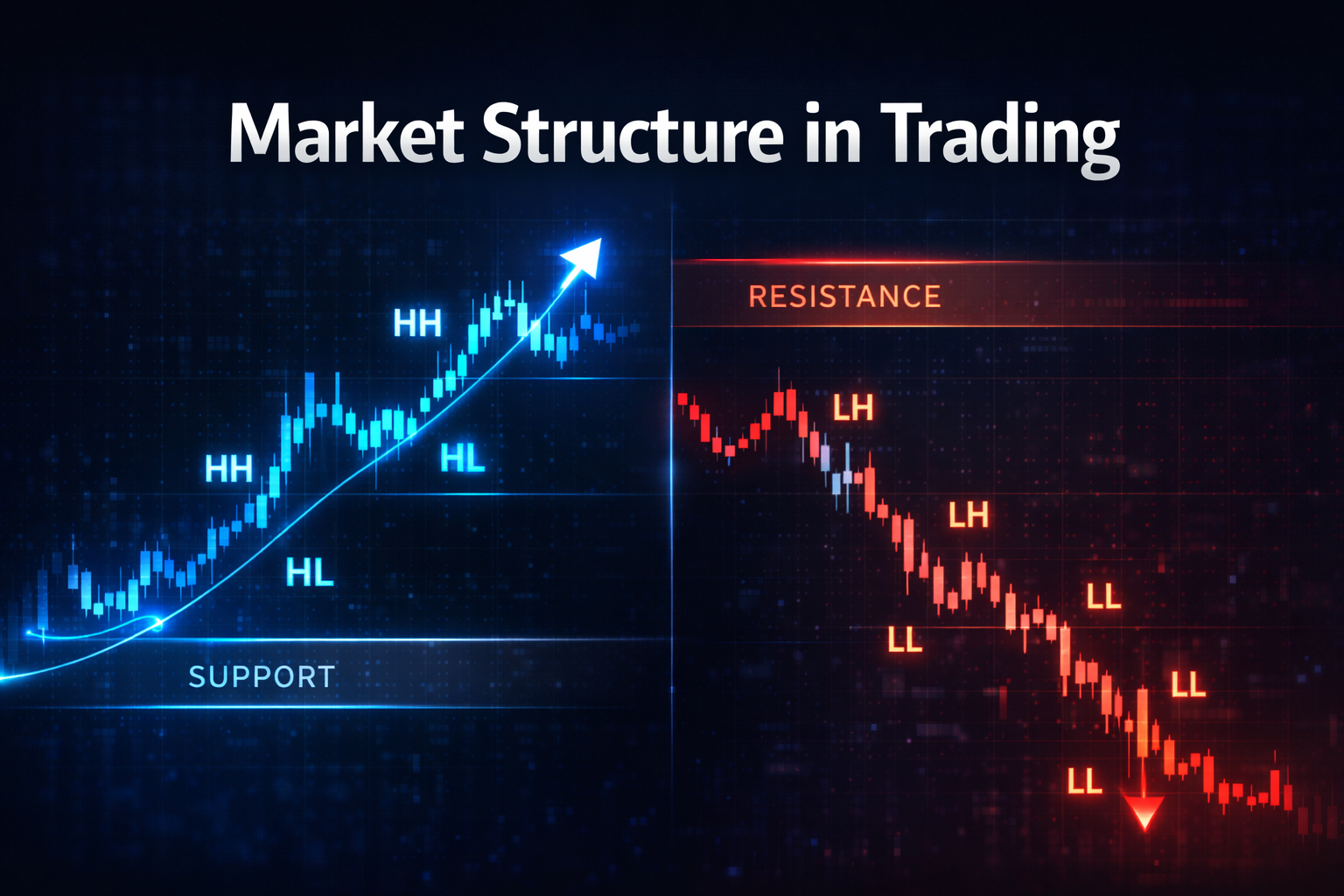
1. Uptrend (Bullish Market) 📈
An uptrend forms when price creates:
- Higher Highs (HH)
- Higher Lows (HL)
👉 This shows buyers are in control.
Example flow:
HL → HH → HL → HH
2. Downtrend (Bearish Market) 📉
A downtrend forms when price creates:
- Lower Highs (LH)
- Lower Lows (LL)
👉 This shows sellers are in control.
Example flow:
LH → LL → LH → LL
3. Range (Sideways Market)
A ranging market moves between:
- Support
- Resistance
👉 No clear direction — price moves sideways.
Key Market Structure Concepts
1. Break of Structure (BOS)
A Break of Structure happens when price breaks a previous high or low.
- In an uptrend → break above previous high
- In a downtrend → break below previous low
👉 This confirms continuation.
2. Change of Character (CHoCH)
This is when the market shifts direction.
Example:
- Uptrend → price breaks a previous low
👉 Possible reversal
3. Support and Resistance
- Support = price floor
- Resistance = price ceiling
👉 These are key areas where structure forms.
How to Identify Market Structure (Step-by-Step)
Step 1: Zoom Out
Start with a higher timeframe (H1, H4, Daily)
Step 2: Mark Highs and Lows
Identify:
- Swing highs
- Swing lows
Step 3: Identify Trend
- HH + HL → Uptrend
- LH + LL → Downtrend
Step 4: Wait for Confirmation
Look for:
- Break of structure
- Retest
Why Market Structure Is Important
Understanding market structure helps you:
- Avoid trading against the trend
- Find better entries
- Improve risk management
- Increase consistency
👉 It removes emotional trading.
Common Beginner Mistakes
❌ Ignoring higher timeframe structure
❌ Trading inside a range like a trend
❌ Entering before confirmation
❌ Overcomplicating analysis
Pro Tip (Very Important)
Always trade with structure, not against it.
👉 The trend is your edge.
How Market Structure Connects to Other Concepts
Market structure works together with:
- Supply and demand
- Support and resistance
- Liquidity concepts
- Risk management
👉 This is where real trading skill develops.
Conclusion
Market structure is one of the most important skills in trading.
Once you understand it, you’ll:
- Read charts with confidence
- Identify trends early
- Avoid unnecessary losses
🚀 Start Practicing with Real Tools
👉 https://forexbroker500.com/
👉 https://app.forexbroker500.com/
Use calculators, tools, and resources to apply what you’ve learned.

No responses yet