
Introduction
If you’re trading without understanding spreads and commissions…
you’re already losing money.
Most traders focus on entries and exits — but ignore trading costs.
And over time, these costs quietly eat into profits.
In this guide, you’ll learn exactly:
- What spreads and commissions are
- How they impact your trades
- How to reduce trading costs like a pro
What is a Spread in Forex?

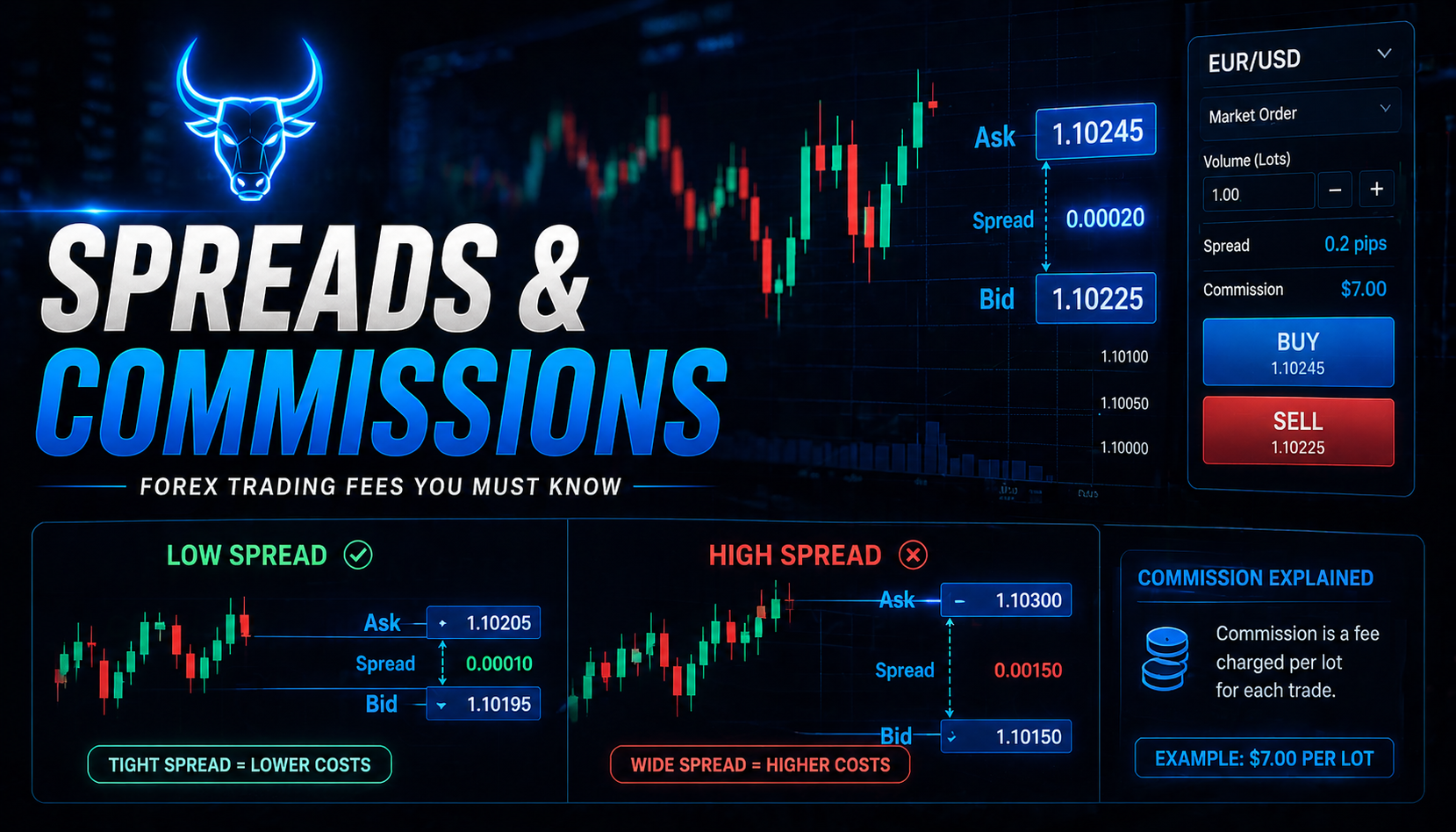
A spread is the difference between the bid price and the ask price.
- Bid price → Price you sell at
- Ask price → Price you buy at
👉 This difference is how brokers make money.
Example:
If EUR/USD shows:
- Buy (Ask): 1.1002
- Sell (Bid): 1.1000
The spread = 2 pips
Types of Spreads
1. Fixed Spread
- Stays constant
- Easier for beginners
- Usually higher
2. Variable (Floating) Spread
- Changes with market conditions
- Lower during high liquidity
- Higher during news/events
👉 Most professional traders prefer variable spreads.
What is a Commission in Forex?
A commission is a separate fee charged per trade.
It’s common in:
- ECN accounts
- Raw spread accounts
Instead of wide spreads, you get:
✔ Very tight spreads (sometimes 0.0 pips)
❌ But pay a commission per lot

Spread vs Commission: Which is Better?

There’s no “one-size-fits-all” answer.
Standard Accounts (Spread Only)
- Easier to understand
- No separate fees
- Higher overall cost
ECN Accounts (Spread + Commission)
- Lower spreads
- More transparent pricing
- Better for active traders
👉 If you trade frequently → ECN is usually better
👉 If you trade occasionally → standard may be fine
How Spreads Affect Your Profit

Every trade starts negative because of the spread.
That means:
- Price must move in your favor just to break even
- The larger the spread → the harder it is to profit
👉 This is critical for:
- Scalpers
- Day traders
Hidden Trading Costs You Must Know
Most traders only think about spreads and commissions…
But there’s more:
1. Swap Fees (Overnight Fees)
Charged when you hold trades overnight
2. Slippage
Difference between expected price and executed price
3. Spread Widening
Happens during:
- News releases
- Low liquidity periods
👉 These costs can destroy profitability if ignored.
How to Reduce Trading Costs
✅ Trade During High Liquidity
Best time: New York & London sessions
✅ Avoid News Spikes
Spreads widen during volatility
✅ Choose the Right Account Type
Match your strategy (scalping vs swing trading)
✅ Use Proper Risk Management
Small costs compound over time
Tools to Control Your Trading Costs
To stay profitable, you need precision tools:
- Lot size calculator
- Risk management tools
- Trade planning tools
🧰 Use the Trader Toolkit App:
Final Thoughts
Spreads and commissions may seem small…
But over hundreds of trades, they become massive.
Smart traders:
- Factor in costs before entering
- Choose the right accounts
- Trade at optimal times
That’s how you protect your edge.
Take the Next Step
Want to trade smarter and scale faster?
Access funding opportunities, improve your strategy, and grow without risking your own capital.
Disclaimer
Forex Broker 500 is an educational platform and not a broker. We do not accept deposits or execute trades. We may partner with proprietary trading firms and affiliate providers. Trading involves risk, and past performance does not guarantee future results.

No responses yet