
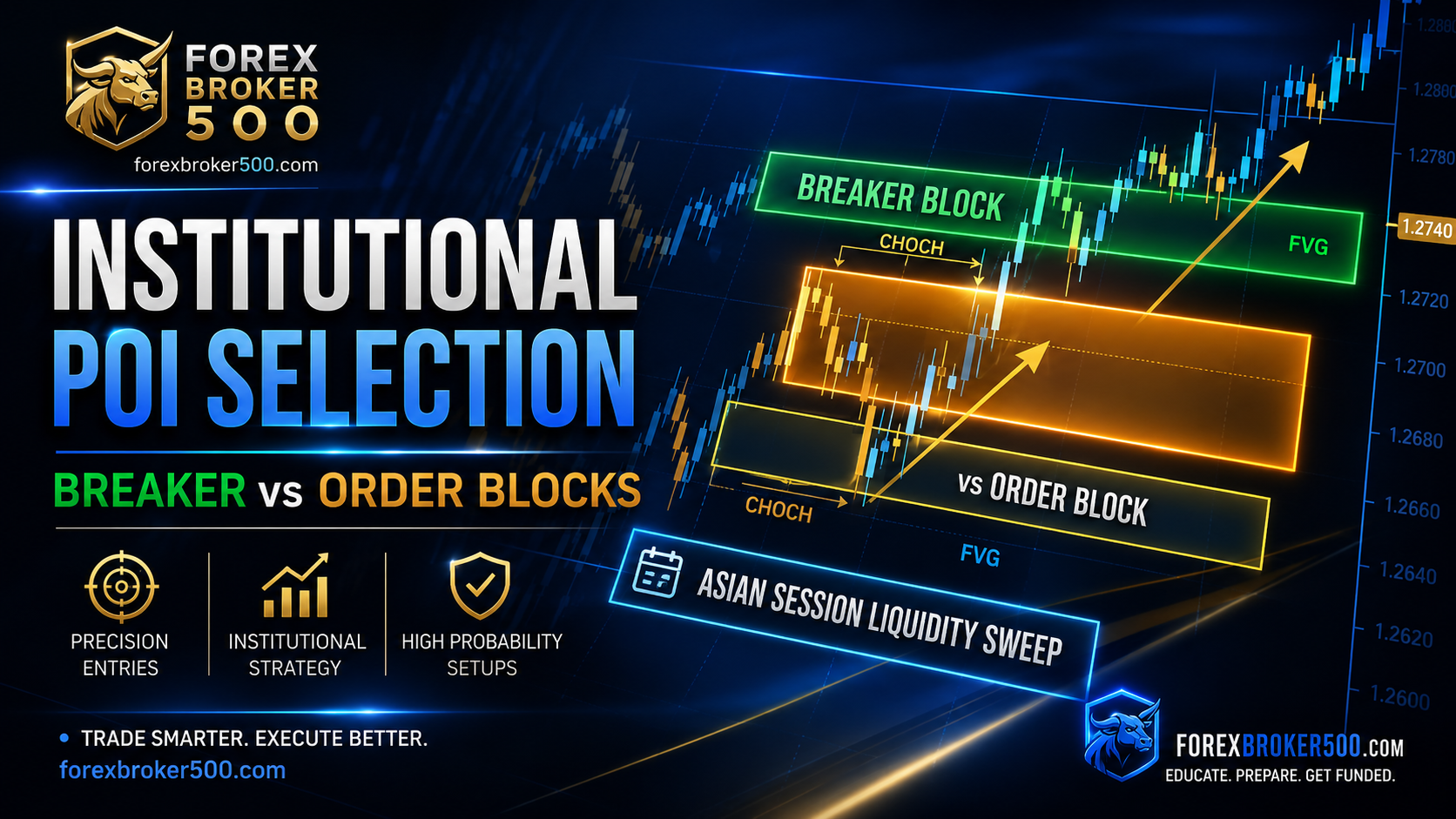
Executing a textbook Change of Character or Break of Structure means nothing if your Point of Interest (POI) is fundamentally flawed. In our previous guide on SMC entry models and structural shifts, we broke down how to identify entry triggers. However, many proprietary trading firm challenges are still failed because traders execute off unmitigated, low-probability zones where institutional algorithms have no structural intent to defend price.
To pass evaluations and keep your funded account active, you must transition from guessing retail support and resistance levels to mapping institutional POIs with surgical precision.
The Flaw in Standard POI Mapping
Retail traders often mark every single swing high or swing low as a valid supply or demand zone. Smart Money Concepts (SMC) improve upon this by looking for Order Blocks (OB), Breaker Blocks, and Fair Value Gaps (FVG). However, novice traders still blow accounts because they treat all OBs equally.
An unmitigated order block sitting in the middle of a range or against the higher-timeframe (HTF) trend is an execution trap. Institutional algorithms routinely run these intermediate pools of liquidity to purge retail breakout and reversal traders before continuing the true institutional delivery leg. Understanding this distinction is critical to avoiding the common pitfalls covered in our breakdown on why traders fail prop firm funding math.

Key Distinction:
- Retail Zone: Drawn based on how many times price previously bounced off a horizontal line.
- Institutional POI: The exact candle or zone where bank algorithms injected liquidity, created an imbalance, and swept retail stops prior to a structural displacement.
The POI Quality Matrix (Scoring System)
Before risking capital on an evaluation, run every potential POI through a strict quality filter. A high-probability institutional POI requires a minimum score across three core structural elements:
- The Liquidity Sweep Precedent: Did the move leading into the POI sweep existing retail liquidity (such as equal highs/lows or Asian session liquidity)? As we highlighted in our study on the anatomy of a liquidity hunt, zones formed after a liquidity purge carry significantly higher institutional volume.
- Displacement & Imbalance: Does the impulse move away from the POI leave behind a clean Fair Value Gap (FVG) or Balanced Price Range? True institutional participation leaves structural footprints of aggressive market orders.
- HTF Alignment: Is your execution POI aligned with the 4-Hour or Daily market structure direction? Trading minor retracements against HTF order flow drastically shrinks your reward-to-risk ratio.
Timeframe Refinement Rules (4H to 15M/5M)
Trading an unrefined 4-Hour Order Block leads to wide stop losses, which damages your risk-to-reward ratio and exposes you to violation of daily loss limits vs max drawdown rules. Refinement solves this by scaling down into lower timeframes (LTF) to pinpoint the exact origin of the institutional drive.
- Step 1: Identify the HTF Zone. Mark out the 4H or 1H Order Block that caused the break of structure.
- Step 2: Drop to the LTF (15M or 5M). Look inside the 4H zone for the specific candle sequence that initiated the aggressive expansion.
- Step 3: Isolate the Extreme POI. Refine your entry box from the entire 4H candle down to the last opposing candle (or mitigation block) on the 15M chart before the displacement leg started. This tightens your stop loss and maximizes your RR.
🚀 Pass Your Challenge with the FB500 Funding Edge Strategy
Stop guessing POIs and struggling with strict prop firm drawdown rules. Get the complete blueprint engineered specifically to pass funded account challenges and keep your capital safe.
- Institutional Entry Indicators: Precision tools for MetaTrader & TradingView.
- Step-by-Step Execution Rules: Exact criteria for entry, stop placement, and profit targets.
- Risk Management Matrix: Protect your daily drawdown while scaling up payouts.
👉 Get Instant Access to the FB500 Funding Edge Strategy Here
Execution Protocol: Confluence Checklist
Never place a pending limit order blindly when price taps your refined POI. Protect your account equity using this mandatory confirmation checklist:
- HTF Trend Alignment: Price is moving in harmony with dominant weekly/daily order flow.
- Liquidity Purge Complete: The market has swept internal liquidity just prior to touching the POI.
- LTF Reaction: Price reacts sharply off the refined POI, printing an immediate lower-timeframe CHoCH or FVG confirmation.
- Strict Drawdown Control: Stop loss is securely placed beyond the structural invalidation point, risking no more than 0.5% to 1% per trade to adhere to funded account management rules.

No responses yet