
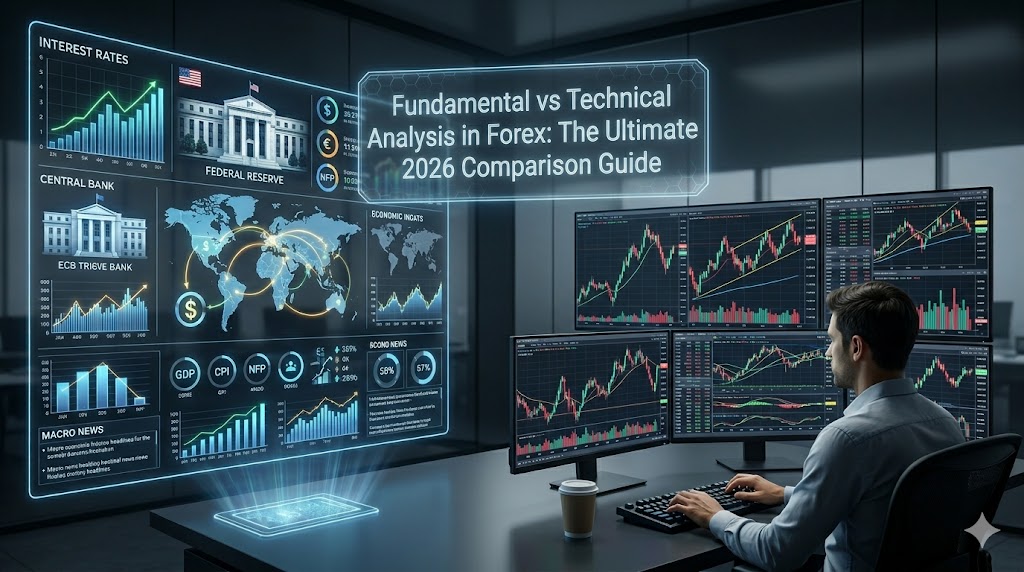
Introduction: The Great FX Debate — Syntax of the Markets
In the hyper-liquid landscape of the 2026 foreign exchange market, traders are confronted with an overwhelming deluge of real-time data. To navigate this chaotic environment and pull consistent profits from currency fluctuations, participants rely on two foundational methodologies: Fundamental Analysis and Technical Analysis. While originally popularized within equity spaces, these two analytical disciplines take on entirely unique, high-stakes characteristics when applied to the global currency markets.
Fundamental analysis serves as the macroeconomic bedrock, examining the underlying economic health, structural indicators, and monetary policies of sovereign nations to determine the intrinsic value of a currency pair. Conversely, technical analysis completely bypasses the “why” behind market movements, focusing exclusively on the “what.” It treats price action as a pure, visual manifestation of market psychology, utilizing historical data, structural patterns, and algorithmic mathematical indicators to forecast future directional probabilities.
For the modern retail speculator or professional prop firm participant, choosing between these two systems is not a binary mandate. It is an operational decision regarding your trading horizon, risk tolerance, and execution style. Understanding how these forces interact is the first critical step toward building a sustainable edge in the global currency arena.
1. Deconstructing Forex Fundamentals: The Macro Engine

Unlike stocks—where fundamental analysis centers around corporate balance sheets, quarterly earnings reports, and management teams—forex fundamental analysis focuses entirely on sovereign macroeconomics. When you trade a currency pair, you are essentially buying a share in one nation’s economy while shorting another. Therefore, the fundamental analyst must monitor the structural catalysts that dictate global capital flows.
Interest Rates and Central Bank Mandates
The single most powerful force driving long-term currency valuations is the benchmark interest rate set by central banks, such as the Federal Reserve (Fed) or the European Central Bank (ECB). Capital naturally flows toward jurisdictions offering higher yields. If a central bank hikes interest rates to combat inflation, global institutional investors aggressively shift capital into that nation’s fixed-income assets, driving up demand—and the spot price—of the domestic currency.
Macroeconomic Indicators
Fundamental analysts closely monitor highly anticipated events on the economic calendar. The most impactful include:
- Gross Domestic Product (GDP): The definitive scorecard of a nation’s overall economic output and structural health.
- Consumer Price Index (CPI): The standard metric used to track inflationary velocities, which directly influences central bank interest rate decisions.
- Employment Data (e.g., Non-Farm Payrolls – NFP): Measures labor market resilience. Strong employment numbers signal an expanding economy, often giving central banks the green light to tighten monetary policy.
While fundamental analysis provides an incredibly reliable macro bias, its primary drawback is timing. An economy may be structurally weak, but a currency can remain irrationally strong for weeks or months due to speculative positioning. For this reason, long-term position traders and macro hedge funds find fundamentals indispensable, whereas short-term intraday scalpers often view them purely as high-risk volatility events to avoid.
2. Mastering Forex Technicals: The Psychology of Price Action
Technical analysis operates under a radical, contrasting premise: the market discounts everything. Technical traders argue that every fundamental data point, central bank rumor, and geopolitical event is already instantaneously factored into the live spot price of a currency pair. Therefore, studying economic spreadsheets is redundant; the chart ledger itself holds all the answers.
Technical Analysis Flow: Historical Price Data -> Structural Pattern Recognition -> Algorithmic Confirmation -> Execution
Price Action and Market Architecture
At its core, technical analysis relies on identifying structural repetitions. Because human emotion—fear, greed, and herd mentality—remains unchanged, price patterns repeat themselves across every imaginable timeframe. Modern forex technical analysis has moved past lagging retail indicators like basic moving averages. Today’s professional landscape focuses heavily on market microstructure:
- Support and Resistance Zones: Structural areas where historical buying or selling pressure has reliably reversed price trends.
- Order Blocks and Liquidity Pools: Visual footprints on the chart where institutional market makers have left massive block orders unfulfilled.
- Fibonacci Retracement Levels: Mathematical ratios used to identify high-probability pullbacks within an established trending market.
The primary advantage of technical analysis is its extreme operational precision. A technical chart tells a trader exactly where to enter, precisely where their directional bias is proven wrong (stop-loss), and exactly where to harvest profits (take-profit). However, its vulnerability lies in false breakouts and unexpected “noise.” During periods of low liquidity or sudden headline news shocks, technical structures can break down instantly, trapping undisciplined traders on the wrong side of the market.
3. Accuracy, Profitability, and the Power of Backtesting
A perpetual debate echoes through trading forums: Which methodology is mathematically superior in terms of accuracy and raw profitability? The reality is that neither system possesses an inherent monopoly on market truth. Profitability is entirely dependent on how systematically a strategy is backtested, optimized, and executed.
Systemic Optimization Path: Formulate Rules -> Historical Backtesting -> Forward Demo Testing -> Live Capital Allocation
To determine the accuracy of a technical or fundamental system, traders deploy rigorous backtesting trading strategies. By running a rule-based methodology through years of historical market data, a trader can uncover the strategy’s exact win rate, average risk-to-reward ratio, and maximum historical drawdown.
Backtesting reveals that pure technical analysis shines brightest in lower-timeframe environments (such as the 5-minute or 15-minute charts), where structural setups occur frequently enough to exploit a mathematical edge. Fundamental models, when backtested over multi-year cycles, prove highly accurate at catching massive, thousand-pip structural trend reversals on the daily and weekly charts. Ultimately, profitability is less about the analysis type you select, and more about your absolute discipline in maintaining strict risk limits during inevitable drawdown cycles.
4. Designing a Strategy Tailored to Your Goals and Risk Profile
Selecting your ultimate trading style requires deep personal alignment with your psychological makeup, lifestyle constraints, and individual risk profile. Trying to trade a system that conflicts with your personality is the fastest path to emotional ruin and blown accounts.
| Trading Classification | Analytical Focus | Typical Holding Time | Ideal Psychological Profile |
| Scalper / Intraday Trader | 100% Technical Analysis | Minutes to Hours | Highly disciplined, comfortable with fast choices, thrives under pressure. |
| Swing Trader | 80% Technical / 20% Fundamental | Days to Weeks | Patient, analytical, prefers looking at charts once or twice a day. |
| Position Trader | 80% Fundamental / 20% Technical | Weeks to Months | Macro-focused, unbothered by short-term volatility, long-term horizon. |
For beginners entering the forex arena, the wisest starting path is to master standard risk management trading strategies using basic price action structures on higher timeframes. As your experience expands, you can begin integrating macro fundamentals to build a comprehensive view. Your objective should be to cultivate a systematic routine where every trade entry is backed by cold, unyielding statistical data rather than an emotional hunch.
5. The Confluence Model: Merging Both Worlds for an Elite Edge
The highest-performing traders in the world rarely rely on one single school of thought. They achieve peak performance by combining fundamental and technical analysis into a single, unified operational framework known as the Confluence Model.
The Confluence Engine: Macro Fundamental Analysis (Establishes the Direction) + Micro Technical Analysis (Triggers the Entry)
By utilizing fundamentals to determine what direction to trade (e.g., buying the US Dollar because of rising interest rates) and technical analysis to determine exactly when and where to enter (e.g., waiting for price to pull back to a pristine 1-hour bullish order block), you create a highly resilient strategy. This multi-layered approach dramatically reduces false signals, filters out low-probability setups, and maximizes your structural edge against the market makers.
Technical Integration & Capital Allocation
Optimizing Your Technical Workspace
To execute a combined technical and fundamental strategy at an institutional level, your digital workstation must be anchored by cutting-edge architecture. Accessing real-time feed updates and avoiding trade slippage during volatile news events requires highly optimized software infrastructure.
Traders can explore our comprehensive Forex Broker Reviews hub to compare platform execution speeds globally. To ensure your automated scripts, chart templates, and technical indicators perform flawlessly without lag, ensure your daily operations are routed through high-speed MT5 trading accounts. Furthermore, choosing an environment backed by low spread forex brokers guarantees that your micro-transaction fees remain flat, preserving your equity curve as you scale your capital.
Live Technical vs. Fundamental Bias Matrix
To help you visually track when both analysis models line up perfectly before risking your capital, use our interactive confluence sandbox below to score your trade setups in real time:
Elevate Your Capital and Execution Strategy
Take Control of Your Trading Career
Whether your unique strategy relies on sweeping lower-timeframe liquidity wicks or tracking global macro interest rate cycles, your analytical skill requires an unconstrained environment to thrive.
By registering your direct live account on the Forex Broker 500 Main Page, you break free from arbitrary third-party restrictions. Secure immediate access to deep tier-1 institutional liquidity pools, customizable retail leverage profiles, and raw pricing environments where you retain 100% of your hard-earned trading profits.
Capitalize Your Edge: The FB500 Funding Edge Strategy
For sophisticated traders who have successfully formulated a backtested, high-confluence trading strategy but lack the necessary capital backing to generate substantial wealth, an institutional solution is available.
The premier FB500 Funding Edge Strategy bridges the gap between talent and capital by providing institutional-grade corporate funding allocations to qualified professionals. Circumvent the restrictions of traditional retail accounts, scale your position sizing safely using large-scale corporate funds, and partner with an elite funding framework engineered explicitly to maximize your long-term operational success.

No responses yet