
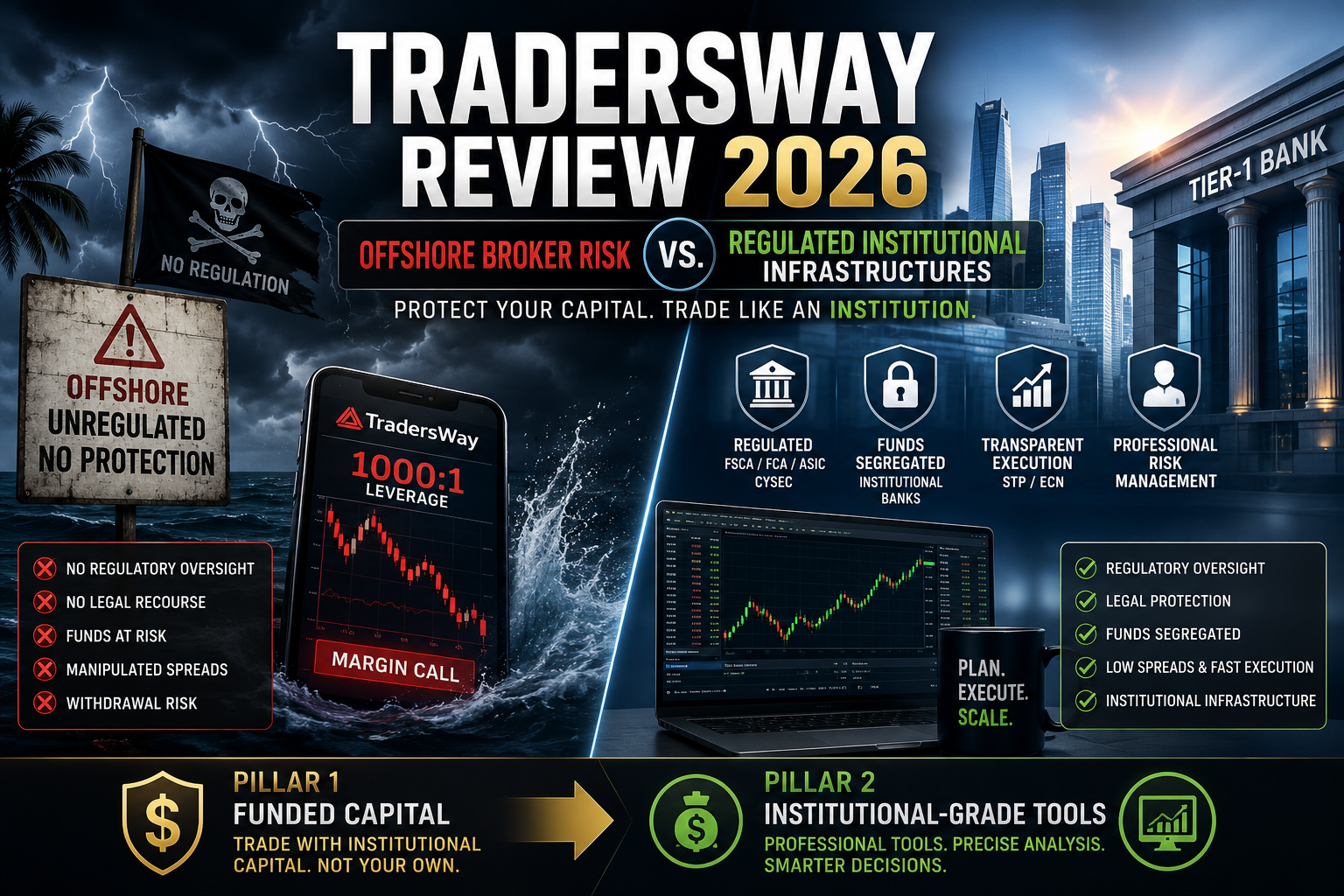
Are you looking for an honest TradersWay review or investigating their advertised $10 minimum deposit and 1000:1 leverage accounts?
Before you risk your hard-earned capital with an unregulated, offshore entity, you need a reality check on the modern trading landscape. While the retail trading space was once dominated by unregulated Caribbean brokerages offering extreme leverage, the industry has shifted. Professional traders have moved away from offshore risk and transitioned toward institutional security, strict regulatory oversight, and funded capital structures.
This is not just another review. This is a masterclass in capital preservation, the systemic risks of unregulated offshore brokerages, and how to transition to institutional-grade trading pathways.
The Threat of the Offshore Grey Zone
For over a decade, brokers registered in offshore tax havens like Dominica (such as TW Corp / TradersWay) have attracted retail traders with a simple promise: high leverage (up to 1000:1), low barriers to entry, and zero regulatory hurdles.
But as a serious trader, you must ask yourself: What happens to your money when things go wrong?
When you trade with an unregulated offshore broker, you forfeit almost all modern financial safety nets:
- No Genuine Regulatory Oversight: Unregulated brokers do not answer to strict financial watchdogs such as South Africa’s FSCA, the UK’s FCA, or Europe’s CySEC. If a pricing dispute, execution anomaly, or withdrawal freeze occurs, you have zero local legal recourse or ombudsman to fight your case.
- The Danger of “Virtual” Segregation: While offshore brokers often claim to keep client funds in segregated accounts, there are no independent, third-party regulatory audits to prove those funds aren’t being used for corporate operational expenses or market-making liquidity.
- Slippage and Spread Manipulation: Without a strict regulator looking over their shoulder, offshore entities can widen spreads arbitrarily during minor market events or subject your trades to massive slippage, wiping out retail accounts with zero accountability.
Do you want to stop guessing your entry points? Instead of fighting bad broker execution, arm yourself with our high-probability indicator suite. Download our Top 20 Forex Trading Indicators for Free right now to instantly upgrade your technical chart setups.
Retail Speculation vs. Institutional Infrastructure
If your goal is to trade for a living, you must stop behaving like a retail gambler and start operating like an institutional fund manager.
Let’s compare the structural differences between the outdated offshore broker model and a professional, highly regulated trading environment:
| Feature | The Offshore Retail Model (e.g., TradersWay) | The Regulated / Institutional Model |
| Regulation | None. Registered as a business entity in Dominica. | Strict. FSCA, FCA, ASIC, or CySEC oversight. |
| Capital Origin | 100% Personal retail capital at risk. | Professional prop firm allocation (No personal risk). |
| Leverage | Excessively high (Up to 1000:1) — a recipe for rapid margin calls. | Controlled, professional risk management environments. |
| Fund Security | No regulatory safety net or deposit insurance. | Segregated bank accounts with tier-1 institutional banks. |
| Slippage & Spreads | Unregulated execution; high risk of “stop-hunting”. | Direct, audited STP/ECN market execution. |
Keeping Capital Safe: The Modern Trading Pathway
If you are serious about protecting your trading capital, you must pivot away from putting your own cash into offshore, unregulated accounts. The modern, professional pathway consists of two pillars:
Pillar 1: Transition to Funded Capital (No Personal Risk)
Why risk $1,000 of your own money at a high-leverage offshore broker when you can trade a $100,000 buying power account funded by institutional capital?
By utilising professional proprietary trading firms, you eliminate broker insolvency risk completely. You pass a simulated evaluation using institutional risk rules, and the prop firm provides you with the trading capital while taking on the downside risk.
If you are ready to scale your trading size without risking your personal savings, explore our vetted institutional funding partners and strategies directly on our Forex Broker 500 Homepage.
Pillar 2: Deploy Institutional-Grade Tools
Professional trading requires professional tools. Unregulated retail platforms are often slow, lag during high-impact news, and lack execution transparency.
Ensure your chart analysis is flawless before you take any evaluation or execute any live order.

No responses yet