
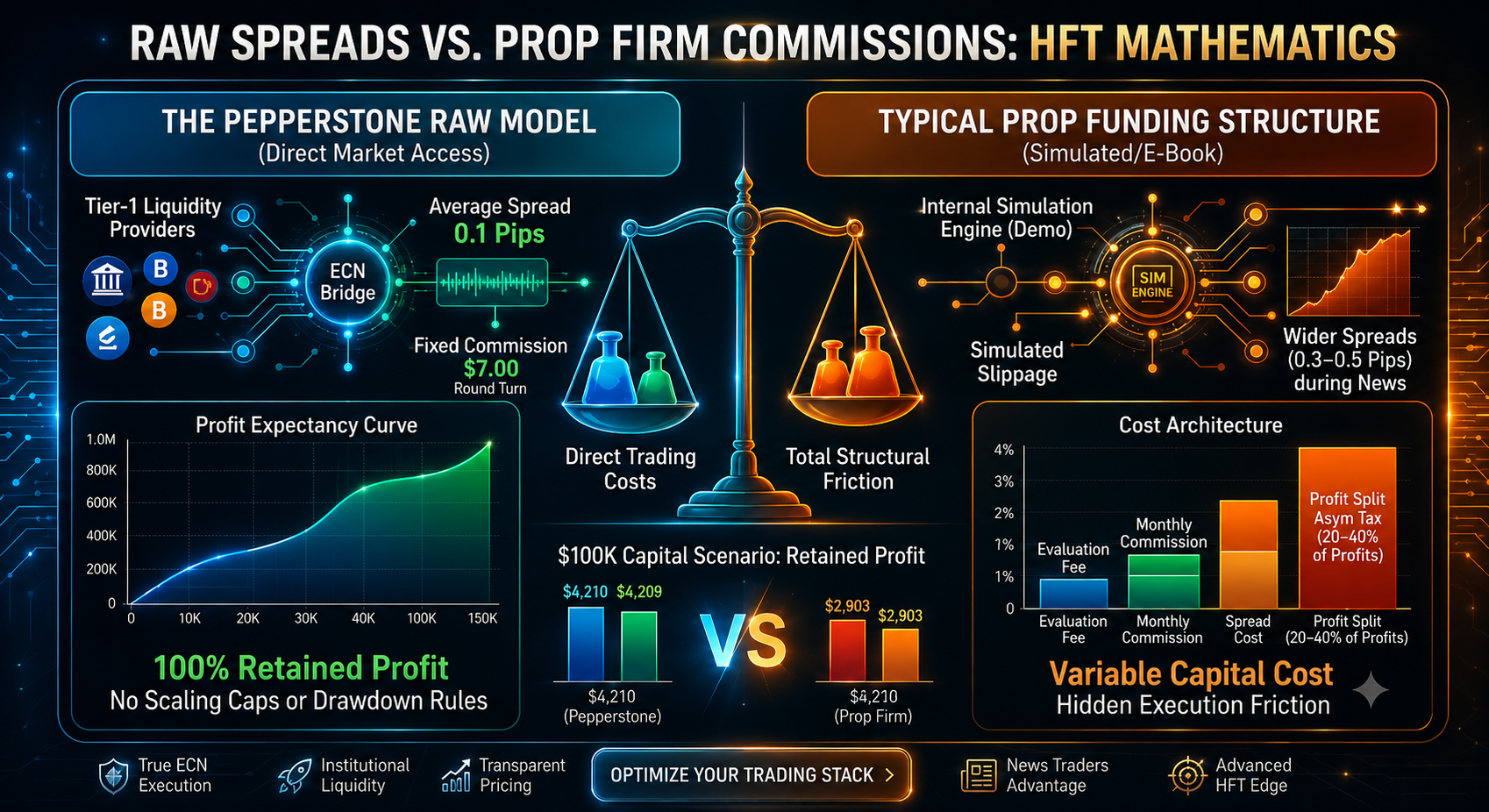
For high-frequency traders (HFT), scalpers, and algorithmic executioners, the true cost of trading is never just about the direction of the market. It is an engineering problem. Every micro-pip shaved off a spread or saved on a commission directly alters the expectancy curve of an automated or high-volume strategy.
With the massive surge in modern prop firm funding models over the last few years, a critical structural question has emerged for retail-institutional traders: Is it mathematically more profitable to trade large capital allocations under a prop firm’s commission-and-split structure, or to run raw institutional spread models directly through a prime retail broker like Pepperstone?
Let’s break down the hidden friction points, execution mechanics, and pure mathematical realities of both environments.
1. The Anatomy of Retail Institutional Pricing: The Pepperstone Raw Model
To understand the comparison, we must first look at true retail-institutional routing. Pepperstone’s Raw Account operates on an Electronic Communication Network (ECN) style infrastructure, sourcing liquidity directly from top-tier investment banks and dark pools.

The Cost Architecture
- The Spread: For major pairs like EUR/USD, the spread frequently hits a true
0.0 pipsduring high-liquidity sessions (London/New York overlap), averaging roughly0.1 to 0.2 pipsunder normal market conditions. - The Commission: A fixed cost of $3.50 per standard lot per side ($7.00 round turn) when trading in USD base currency.
- The Slippage Metric: True market execution means orders are filled using market depth (VWAP – Volume Weighted Average Price). If you trade large lot sizes, your fill slips naturally through the order book, but without artificial broker markups.
The Mathematical Formula for Retail Raw Trading Cost
$$\text{Total Cost per Trade (Retail)} = (\text{Spread} \times \$10) + \text{Round-Turn Commission}$$
If you execute 1 standard lot of EUR/USD at a 0.1 pip spread, your baseline friction is:
$$(0.1 \times \$10) + \$7.00 = \$8.00 \text{ per lot}$$
Crucially, 100% of the net profit generated belongs to you. There are no scaling caps, consistency rules, or trailing drawdown thresholds to artificially alter your execution psychology.
2. The Mechanics of Modern Prop Funding Cost Structures
Proprietary trading firms present a completely different mathematical equation. They offer massive leverage and deep buying power (e.g., a $100,000 or $200,000 funded account) in exchange for an upfront evaluation fee and a profit-split model (typically 80/20 or 90/10 in favour of the trader).
However, high-frequency and algorithmic traders often overlook the hidden execution friction embedded within these platforms:
The B-Book Slippage Drag
Most modern prop firms operate entirely on demo environments or “B-Book” internal simulation engines, even at the “funded” stage. Because they are not routing directly to real-world Tier-1 liquidity providers in real-time, their execution bridges often introduce simulated slippage, wider virtual spreads during news events, and slight execution delays. A 0.5-pip artificial slip on a high-frequency strategy can destroy its edge entirely.
The Profit Split Asset Tax
The most severe mathematical cost of a prop firm isn’t the commission per lot; it is the profit split.
If your algorithmic setup generates $10,000 in net profits on a funded account under an 80/20 split, your structural cost for utilising that capital is $2,000. When back-calculated into your per-lot trading cost, this “profit tax” functions as an incredibly steep variable commission.
3. The Mathematical Showdown: Trading $100k Capital
Let’s look at a concrete operational scenario. We will compare a high-frequency scalping strategy executing 100 standard lots per month, generating an average performance of 5% net profit ($5,000) on a $100,000 capital base.
| Cost Metric | Pepperstone Raw ECN Account ($100k Balance) | Typical Funded Prop Firm ($100k Evaluation Account) |
| Upfront Fee | $0 (Deposit remains entirely yours) | ~$500 (Refundable only upon passing) |
| Average EUR/USD Spread | 0.1 Pips ($1.00 per lot) | 0.3 to 0.5 Pips due to simulated markups ($3.00 – $5.00 per lot) |
| Standard Commission | $7.00 Round Turn per lot | $7.00 Round Turn per lot |
| Monthly Commission Cost | $700 (100 lots × $7) | $700 (100 lots × $7) |
| Monthly Spread Drag | $100 (100 lots × $1) | $400 (100 lots × $4 average) |
| The Variable Capital Cost | $0 (You keep 100% of your $5,000 profit) | $1,000 (20% Profit Split on $5,000) |
| Total Structural Friction | $800 | $2,100 (Fee + Spread Drag + Split) |
| Actual Retained Profit | $4,200 | $2,900 |
The Verdict on High-Frequency Expectancy
For a high-volume, lower-target strategy (like HFT scalping or grid algorithms), the prop firm structure introduces a massive mathematical drag. The combined weight of the profit split and slightly wider simulated execution environments eats up a significantly higher percentage of the strategy’s gross performance compared to a clean, direct market access retail broker.
4. Balancing the Mathematics: When to Deploy Each Structure
Optimising your trading infrastructure requires a hybrid approach based entirely on your underlying edge.
When to Route via Pepperstone Raw:
- High-Frequency Algorithms: If your strategy relies on lightning-fast execution, ultra-low latency, and true zero-pip spreads to survive.
- Compounders: If your goal is long-term wealth compounding without the looming threat of sudden maximum trailing drawdown rules or consistency algorithms cutting your access to capital.
- News Traders: Direct ECN clearing ensures your orders interact with authentic depth-of-market, preventing the dramatic, artificial fills common on simulated prop firm servers during high-volatility events.
When to Utilise Prop Funding:
Prop funding shines brightest when you have a proven, low-frequency, high-R (Reward-to-Risk) strategy but lack the personal liquid capital to trade size. If you require deep leverage to make your time market-worthwhile, the upfront evaluation fee represents cheap access to risk capital—provided your strategy can withstand the strict, daily drawdown limits.
For serious operators building out their long-term trading infrastructure, true diversification doesn’t just mean trading multiple asset classes; it means balancing your capital routing across both direct personal institutional accounts and prop-funded allocations to balance the mathematics of modern execution friction.
Optimise Your Trading Stack
Before deploying high-volume strategies across raw or funded servers, ensuring your technical edge is flawless is non-negotiable. Take control of your execution setups by integrating our master suite of institutional indicators.
👉 Download the Top 20 Trading Indicators Pack for Free and start refining your system’s entry mechanics today.
If you are looking to scale up your available trading capital using institutional-backed structures, read our definitive roadmap on securing Prop Funding Solutions directly from our home page guide.

No responses yet