
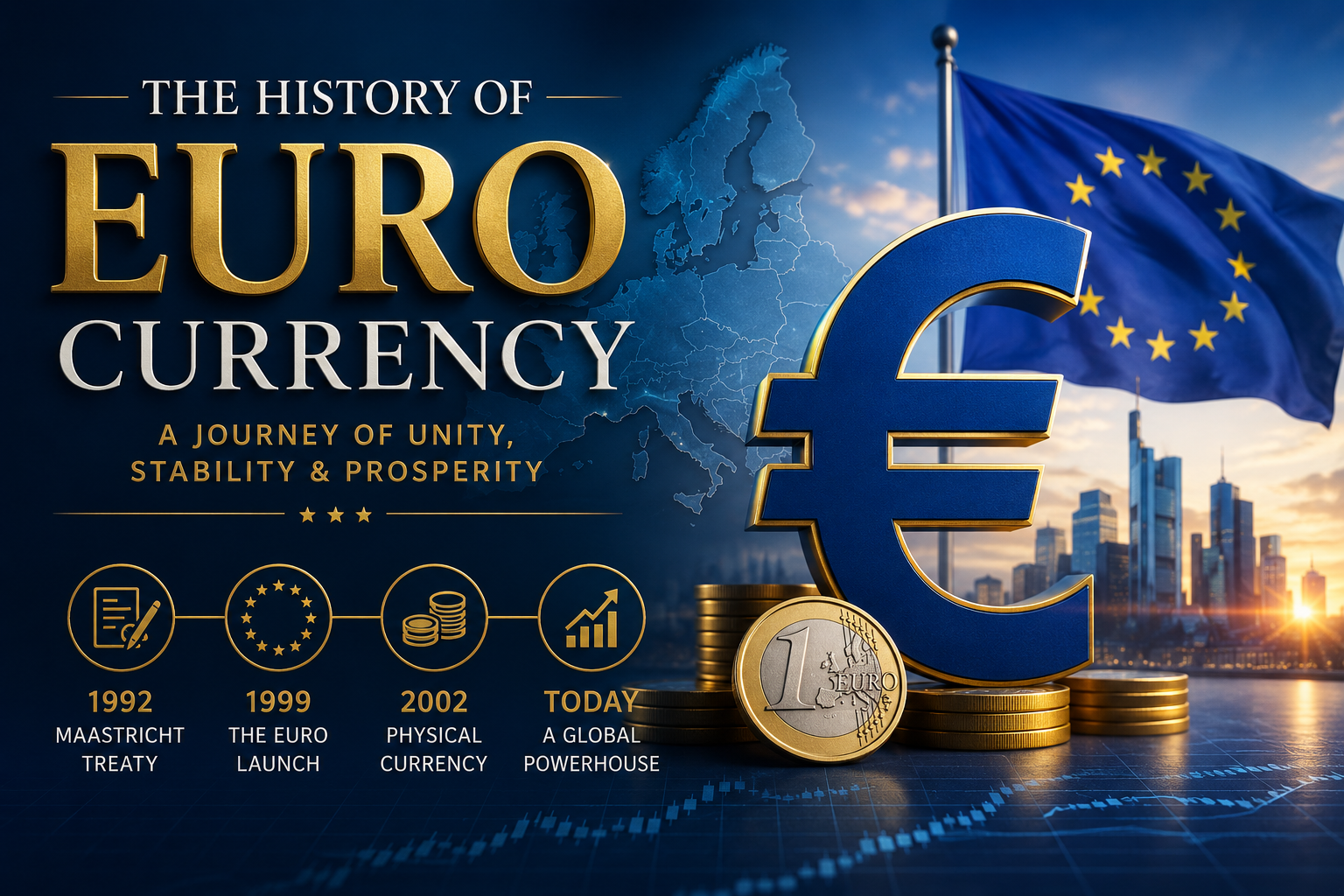
The History of the Euro Currency
The Euro (€) is the official currency of 19 out of 27 European Union member states and stands today as one of the most influential currencies in the global financial system. Introduced on January 1, 1999, the Euro replaced several national currencies and became a major milestone in European economic integration.
Today, the Euro is the second most traded currency in the world after the US Dollar, making it a central focus for forex traders and investors worldwide.
The Origins of the Euro
The idea of a unified European currency began after World War II. European leaders sought stronger economic cooperation to reduce trade barriers and prevent future conflicts through deeper financial integration.
In 1970, the Werner Report proposed the creation of an Economic and Monetary Union (EMU), laying the foundation for a single European currency. Although progress was initially slow due to economic and political challenges, the vision for a shared currency continued to gain support across Europe.
The Maastricht Treaty and the Birth of the Euro

A major breakthrough came with the Maastricht Treaty in 1992. This agreement formally established the roadmap toward creating the Euro and defined the requirements countries needed to meet before adopting the new currency.
The treaty introduced convergence criteria such as:
- Low inflation rates
- Stable exchange rates
- Controlled government debt
- Sound public finances
The treaty also established the European Central Bank (ECB), responsible for managing monetary policy across the Eurozone.
The Transition to the Euro
The transition to the Euro occurred in two major phases.
Phase 1: Electronic Currency Introduction (1999)
On January 1, 1999, the Euro was introduced as an electronic and accounting currency. During this period:
- Financial institutions began using the Euro electronically
- Exchange rates between participating national currencies became fixed
- Physical national currencies remained in circulation
This phase allowed businesses, banks, and governments to gradually adapt to the new monetary system.
Phase 2: Physical Currency Launch (2002)
On January 1, 2002, Euro banknotes and coins officially entered circulation. Over a three-month transition period, national currencies such as the German Deutschmark, French Franc, and Italian Lira were withdrawn.
The launch represented one of the largest currency transitions in financial history, involving billions of banknotes and coins distributed across Europe.
The Euro’s Role in Global Finance
Since its launch, the Euro has become one of the world’s leading reserve currencies. It plays a major role in:
- International trade
- Global investments
- Cross-border transactions
- Forex trading markets
The EUR/USD currency pair is currently one of the most actively traded forex pairs globally due to its liquidity and market influence.
For traders, understanding the history and economic significance of the Euro helps provide deeper insight into market movements and long-term trading trends.
Challenges Faced by the Eurozone
Despite its success, the Eurozone has faced several economic challenges over the years.
The 2008 global financial crisis exposed weaknesses within some member economies, leading to debt crises in countries such as Greece, Portugal, and Spain. These events tested the stability of the Euro and required coordinated economic support from European institutions.
Even so, the Euro has remained resilient and continues to symbolize economic cooperation and unity across Europe.
Why the Euro Matters to Forex Traders
The Euro is one of the most important currencies in the forex market. Economic reports from the Eurozone, ECB interest rate decisions, inflation data, and geopolitical developments can significantly impact currency prices.
Traders who understand the Euro’s history and economic structure are often better positioned to analyze long-term market trends and trading opportunities.
Start Trading Major Currency Pairs with Confidence
If you’re interested in trading EUR/USD and other major forex pairs, explore the funding solutions and trading support available through Forex Broker 500 Funding. Access resources designed to help traders grow their strategies in today’s global forex market.
Conclusion
The history of the Euro currency represents decades of political cooperation, economic planning, and financial integration. From the Maastricht Treaty to becoming one of the world’s most traded currencies, the Euro has transformed international finance and reshaped the European economy.
As global markets continue evolving, the Euro remains a critical currency for governments, institutions, businesses, and forex traders around the world.

No responses yet