
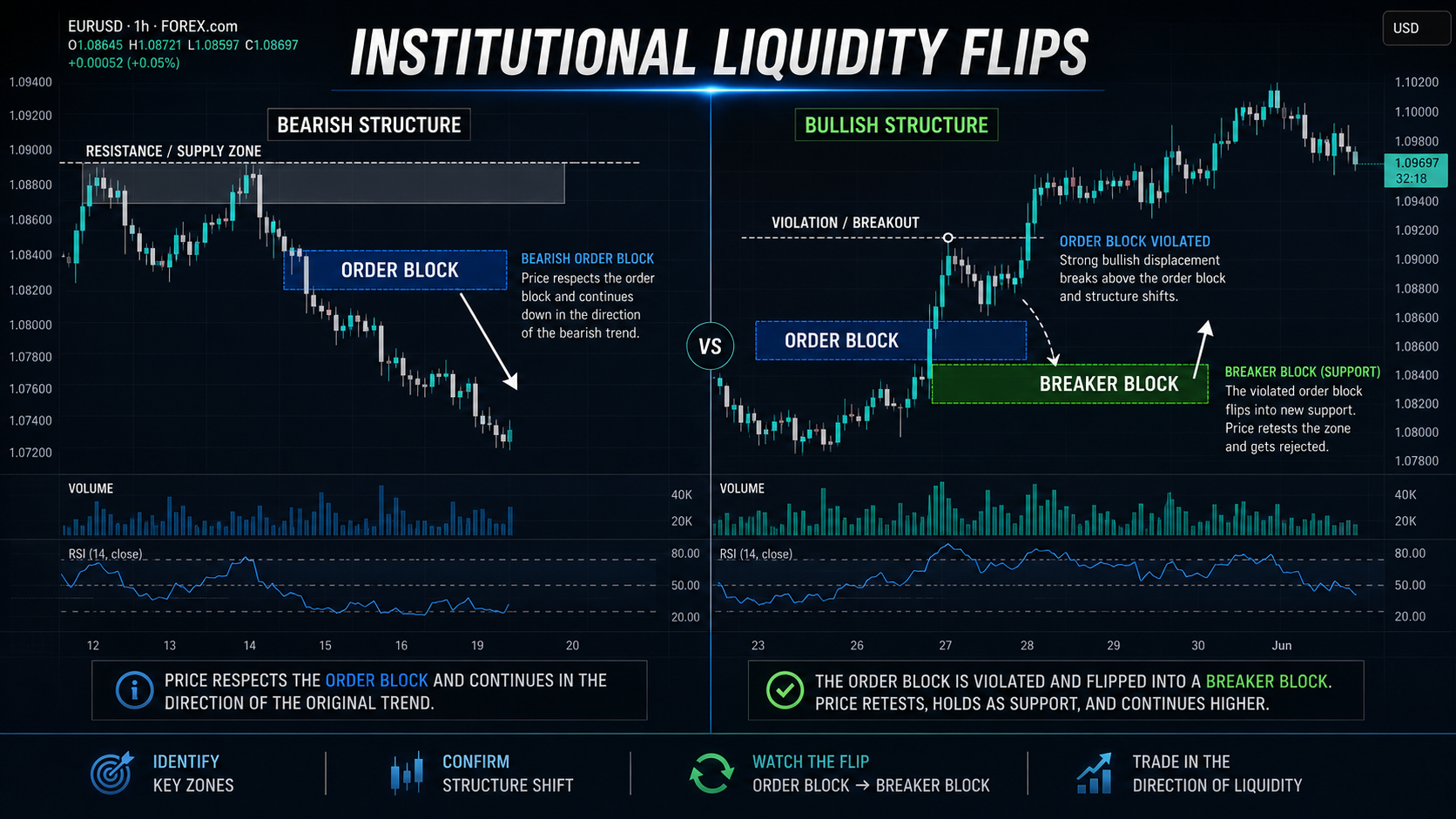
In Smart Money Concepts (SMC), few distinctions matter more than understanding the structural difference between a standard Order Block (OB) and a Breaker Block.
While both concepts identify institutional footprint zones, mistaking a Breaker Block for a standard Order Block leads to premature entries, catching falling knives, and unnecessary stop-outs—especially during high-volatility prop firm evaluations.
Understanding the structural mechanics of both setups, how polarity shifts occur, and how to integrate them into a funded trading strategy provides a clear framework for execution.
1. What is an Order Block?
An Order Block represents a price zone where institutional market participants (banks, hedge funds, and liquidity providers) place large cumulative order blocks before an aggressive directional push.
- Bullish Order Block: The last bearish candle (or cluster of down-close candles) prior to a strong upward expansion that breaks market structure (BOS).
- Bearish Order Block: The last bullish candle prior to an aggressive downward expansion.
When price returns to an untested Order Block, traders anticipate a continuation reaction because institutions seek to mitigate remaining positions or defend their profit margins. However, Order Blocks remain valid only as long as their structural boundaries hold.
For a detailed breakdown of core institutional mechanics, read the complete guide on What is Smart Money Concept (SMC) in Forex.
2. What is a Breaker Block?
A Breaker Block is a failed Order Block that has suffered a structural breach with displacement and flipped its market polarity.
When price fails to respect an active Order Block and instead violently pushes straight through it, the old institutional zone changes role:
- A Bullish Order Block that gets broken down becomes a Bearish Breaker Block (former support flips into resistance).
- A Bearish Order Block that gets broken up becomes a Bullish Breaker Block (former resistance flips into support).

The key reason Breakers work is institutional mitigation. When smart money positions get trapped on the wrong side during a liquidity sweep, they push price back into the violated zone to close out unprofitable positions at breakeven before continuing in the true direction.
3. Key Differences: Order Block vs Breaker Block
| Feature | Order Block (OB) | Breaker Block |
| Zone Status | Untested / Validated Support or Resistance | Violated / Broken Order Block |
| Market Polarity | Original direction (Demand stays Demand) | Flipped direction (Support becomes Resistance) |
| Liquidity Mechanics | Absorbs rest of liquidity on first retest | Formed immediately AFTER liquidity hunt / stop run |
| Confirmation | Requires Break of Structure (BOS) after creation | Requires displacement through OB + Change of Character (ChoCH) |
| Risk Profile | Standard limit entries on zone touch | High probability when aligned with Fair Value Gaps (FVGs) |
4. How to Trade Breaker Blocks Step-by-Step
To maintain consistency and avoid false breaks, follow a strict 4-step confirmation rule:
- Identify Liquidity Sweep: Wait for price to raid a key swing high or low (taking out retail stop losses).
- Observe the Violation: Look for an aggressive displacement candle that cuts directly through the existing Order Block, leaving a Liquidity Imbalance.
- Confirm Polarity Flip: Ensure the break creates a Change of Character (ChoCH) on your target timeframe.
- Execute on Retest: Set limit orders or enter at market when price retraces back into the Breaker Block boundary, placing your Stop Loss just beyond the breaker candle high/low.
5. Integrating Institutional Confluence for Funded Traders
While understanding chart patterns is essential, profitability in funded prop accounts comes down to execution rules and strict risk control.
If you trade evaluation challenges, relying solely on isolated candlestick patterns without structural rules often leads to trailing drawdown breaches. A Breaker Block entry must align with daily bias, session timing (London/NY open), and proper position sizing.
If you are serious about passing evaluations and building consistency without blowing accounts, download the complete systematic framework inside the FB500 Funding Edge Strategy Guide. It combines institutional entry filters with exact drawdown protection mechanics tailored for prop traders.
For additional capital solutions, broker evaluations, and institutional strategy tools to elevate your trading business, visit the ForexBroker500 Homepage to explore our latest trading resources.

No responses yet