
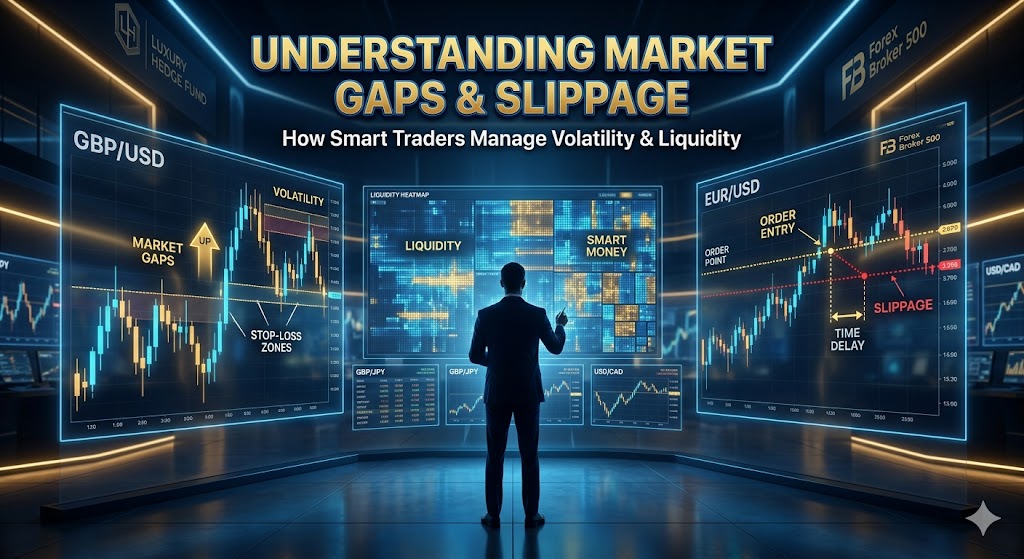
UNDERSTANDING MARKET GAPS AND SLIPPAGE IN TRADING (2026 GUIDE)
Financial markets move fast. In today’s highly connected global economy, prices can change within seconds due to breaking news, economic data, central bank announcements, geopolitical events, or sudden liquidity shifts.
For traders, two of the most misunderstood yet important concepts are market gaps and slippage.
These trading phenomena can dramatically impact profitability, execution quality, and overall trading psychology. Whether you trade forex, indices, stocks, commodities, or cryptocurrency, understanding how gaps and slippage work is critical for long-term survival in the market.
In this complete guide, we break down:
- What market gaps are
- What causes slippage
- Why liquidity matters
- How institutional traders manage execution risk
- Strategies retail traders can use to reduce losses
- How funded traders approach volatile market conditions
What Are Market Gaps?

A market gap occurs when the opening price of an asset is significantly different from its previous closing price.
In simple terms, price “jumps” from one level to another without trading through the prices in between.
Market gaps are common across all financial markets, especially during periods of high volatility or low liquidity.
Example of a Market Gap
Imagine EUR/USD closes on Friday at:
1.1000
Over the weekend, major geopolitical news breaks out.
When the market opens on Monday, EUR/USD opens at:
1.1075
The market skipped 75 pips without trading through the levels between 1.1000 and 1.1075.
That is called a market gap.
Why Do Market Gaps Happen?
Market gaps occur because of sudden imbalances between buyers and sellers.
When there is overwhelming demand or supply before the market opens, price rapidly adjusts to a new equilibrium level.
Common Causes of Market Gaps
1. Economic News Releases
Major economic announcements can trigger explosive volatility.
Examples include:
- Non-Farm Payrolls (NFP)
- CPI inflation reports
- Interest rate decisions
- GDP data
- Employment statistics
These events can instantly shift market expectations and create gaps.
2. Geopolitical Events
Unexpected global events often trigger sharp market reactions.
Examples include:
- Wars
- Elections
- Trade disputes
- Sanctions
- Political instability
Institutional traders react aggressively to uncertainty, causing liquidity disruptions and sudden price movement.
3. Weekend Forex Gaps
Forex markets close on weekends, but global events continue.
When markets reopen on Monday, price may open significantly higher or lower than Friday’s close.
Weekend gaps are especially dangerous for overleveraged traders holding positions without proper risk management.
4. Low Liquidity Conditions
During holidays, session transitions, or thin trading hours, there may not be enough liquidity to support stable pricing.
This can lead to:
- Sudden jumps
- Thin order books
- Large spreads
- Increased slippage
Types of Market Gaps
Understanding gap types helps traders interpret market intent.
Common Gap Types
Breakaway Gaps
These occur when price breaks out from consolidation or a major support/resistance zone.
They often signal the beginning of strong trends.
Exhaustion Gaps
Exhaustion gaps occur near the end of trends and may signal reversals.
These gaps are often fueled by emotional retail participation before institutions reverse price direction.
Continuation Gaps
Also called runaway gaps, these happen during strong trends and suggest momentum continuation.
Common Gaps
These gaps are smaller and usually occur in ranging markets with no major catalyst.
What Is Slippage?
Slippage occurs when your trade is executed at a different price than expected.
This usually happens during:
- High volatility
- Fast-moving markets
- Low liquidity
- News releases
- Large order execution
Slippage can be either positive or negative.
Positive vs Negative Slippage
Positive Slippage
You receive a better execution price than expected.
Example:
You place a buy order at 1.1000 but get filled at 1.0995.
You gained 5 pips of favorable execution.
Negative Slippage
You receive a worse execution price than expected.
Example:
You place a stop-loss at 1.1000 but your order executes at 1.0985.
You lose additional pips because of execution delay and market volatility.
Why Slippage Happens
Slippage is primarily caused by liquidity and execution speed.
When price moves faster than available orders can fill your trade, brokers execute at the next available market price.
Major Causes of Slippage
High Volatility
Fast-moving markets create rapid price fluctuations.
This often happens during:
- News events
- Market opens
- Session overlaps
- Central bank speeches
Low Liquidity
If there are insufficient buyers or sellers at your requested price, your order fills at the next available level.
This becomes more severe during:
- Exotic forex pairs
- Holidays
- Overnight sessions
- Crypto flash crashes
Large Order Sizes
Institutional traders executing massive positions may experience partial fills or multiple execution levels.
This is why banks use advanced execution algorithms to reduce market impact.
How Institutions Manage Gaps and Slippage
Large institutions understand that execution quality is critical.
Banks and hedge funds use sophisticated systems to manage risk.
Institutional Techniques Include
- Algorithmic execution
- Smart order routing
- Liquidity aggregation
- Partial order execution
- Volume-weighted average pricing (VWAP)
- Dark pool execution
Retail traders may not have access to these systems, but they can still improve execution by understanding liquidity behavior.
Why Retail Traders Struggle During Volatility
Most retail traders underestimate volatility risk.
Common mistakes include:
- Overleveraging positions
- Trading major news blindly
- Using tight stop-losses during volatility
- Ignoring liquidity conditions
- Holding trades through uncertain events
This is why many traders fail funded account challenges despite having profitable strategies.
Risk management is often more important than entries.
How to Reduce Slippage and Gap Risk
Professional traders focus heavily on execution quality.
Here are some practical ways to reduce exposure.
1. Use Limit Orders
Limit orders allow traders to define their exact execution price.
Unlike market orders, they prevent excessive slippage.
However, execution is not guaranteed if price never reaches the limit.
2. Avoid Trading During Major News
News trading can be extremely dangerous.
Spread widening and slippage increase dramatically during major releases.
Unless you specialize in volatility trading, it is often safer to wait for post-news stabilization.
3. Reduce Position Size
Smaller position sizes reduce emotional pressure and execution risk.
Professional traders prioritize consistency over oversized gains.
4. Trade High Liquidity Sessions
The London and New York sessions usually offer:
- Tighter spreads
- Better execution
- Higher liquidity
- Lower slippage
Low-liquidity periods often create unpredictable conditions.
5. Use Professional Risk Management
Successful traders understand that preserving capital is the first priority.
This includes:
- Controlled leverage
- Proper stop placement
- Session awareness
- News filtering
- Position sizing discipline
These are core principles behind professional funded trading systems.
Market Gaps, Liquidity, and Smart Money Concepts
Modern trading education increasingly focuses on liquidity.
Institutional traders seek areas where retail stop-losses accumulate because these zones provide liquidity for large orders.
This explains why traders often see:
- Stop hunts
- Liquidity grabs
- Fake breakouts
- Sudden reversals
Understanding liquidity behavior can help traders avoid emotional decisions during volatile conditions.
This is also why many traders now focus on institutional-style execution models rather than relying purely on lagging indicators.
The Role of Psychology During Slippage
Slippage can trigger emotional reactions, especially for inexperienced traders.
Common emotional responses include:
- Revenge trading
- Overtrading
- Panic exits
- Fear of missing out (FOMO)
Professional traders accept that slippage is a natural part of financial markets.
The goal is not to eliminate risk completely — it is to manage risk intelligently.
Funded Trading and Execution Discipline
Funded trading firms evaluate traders heavily on consistency and risk control.
A trader who survives volatile conditions responsibly is often more valuable than one chasing aggressive profits.
This is why many funded traders focus on:
- Liquidity timing
- Session execution
- Controlled risk exposure
- Institutional concepts
- Structured trade plans
The Forex Broker 500 Funding Edge Strategy was designed around these professional concepts, helping traders understand liquidity, execution, and disciplined funded trading behavior.
Learn more:
- https://forexbroker500.com/
- https://forexbroker500.com/funding-edge-strategy/
- https://forexbroker500.com/blog/
Final Thoughts
Market gaps and slippage are unavoidable realities in financial markets.
While they can create risk, they also provide valuable insight into market liquidity, institutional positioning, and volatility dynamics.
The most successful traders are not those who avoid volatility completely — they are the ones who learn how to manage it professionally.
By understanding:
- Market structure
- Liquidity conditions
- Institutional behavior
- Risk management
- Execution timing
traders can dramatically improve long-term consistency and survival.
In today’s fast-moving financial markets, execution quality may be just as important as strategy itself.

No responses yet