
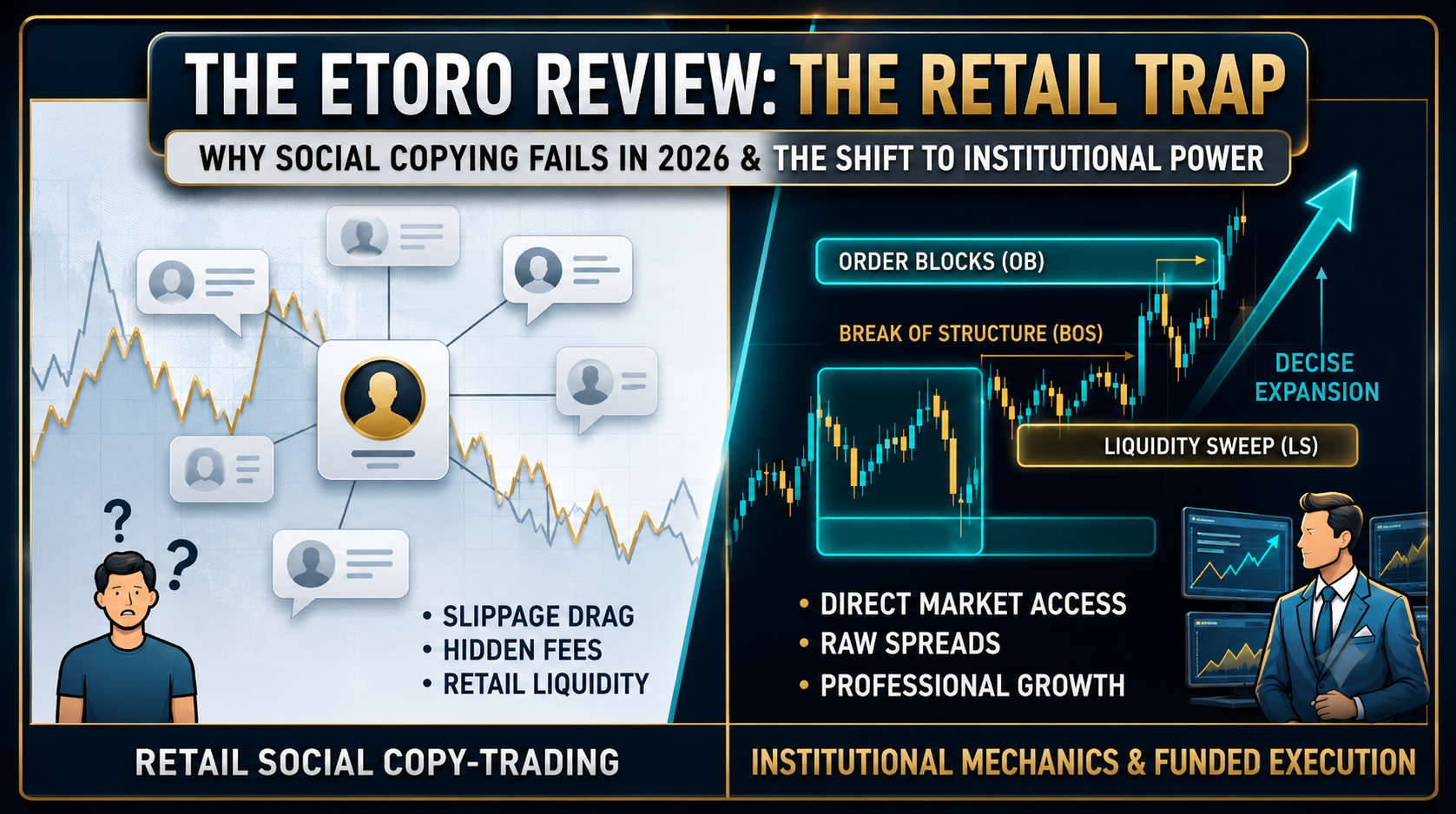
If you are reading an eToro review, you are likely looking for a shortcut to financial freedom. The marketing promise of retail social trading is incredibly seductive: find a “Popular Investor,” click a single “Copy” button, and let their supposedly expert decisions grow your personal capital while you sleep.
But beneath the polished user interfaces and Gamified leaderboards lies a harsh reality.

In modern markets, relying on retail copy-trading systems is a structural trap. While platforms like eToro offer an accessible entry point for beginners to trade equities or basic assets, copying retail traders fundamentally isolates you from true market liquidity, subjects you to hidden execution drag, and caps your growth.
To achieve sustained profitability, you must transition away from retail dependency and toward mastering institutional market mechanics and independent funded execution.
Why Retail Copy-Trading Systems Fail Under the Hood
The foundational flaw of any social copy-trading network is not necessarily the traders you are copying—it is the underlying architectural engineering. Retail networks are optimized for platform engagement, whereas professional trading demands precise order execution.
1. Slippage and Execution Latency Drag
When a popular retail investor opens a position, that order must be duplicated across thousands of coping accounts. This creates a massive queue. By the time your automated copy-trade fills, the market has moved.
- The Result: You suffer heavy slippage (the difference between the expected price of a trade and the price at which the trade actually executes). Over hundreds of trades, this latency drag completely erodes the thin statistical edge the original trader might have had.
2. The Illusion of Risk Management
Most retail platform leaderboards rank traders based on raw percentage gains over short time horizons. This heavily incentivizes dangerous behaviors, such as:
- Martingale Scaling: Adding to losing positions to artificially keep a high win-rate percentage.
- Grid Trading: Grid trading without stop-losses looks perfectly smooth on a historical chart until a sudden market shock completely wipes out the entire account equity.
3. The Spread Mark-up Penalty
Retail copy platforms often compensate their popular investors by widening the bid-ask spreads or factoring hidden transaction commissions into your executions. You are effectively paying a premium price for retail-grade execution that cannot compete with raw institutional feeds.
The Shift to Institutional Mechanics: Smart Money vs. Retail Noise
To stop being liquidity for major institutions, you must learn to read the market through the lens of algorithmic order placement, tracking Smart Money Concepts (SMC) and structural setups.

Instead of relying on lagging retail indicators or hoping a copied account manages risk correctly, professional operators analyze how major market makers move prices:
- Liquidity Sweeps: Central banks and tier-1 institutions must hunt pools of retail stop-losses to accumulate or distribute massive positions.
- Order Blocks: These represent highly specific price zones where institutional market participants have left unfulfilled orders. Price inevitably returns to mitigate these zones.
- Break of Structure (BOS): Identifying when an asset shifts from a minor retail correction to a definitive, macro structural expansion.
By learning to execute independently based on these rules, you take total ownership of your drawdowns, eliminate execution slippage from copy networks, and operate on the exact same plane as institutional algorithms.
The Ultimate Growth Playbook: Advanced Funded Execution
The final piece of the puzzle is capital. Retail copy platforms want you to deposit your own personal capital into their closed ecosystems. If you only have $1,000 to trade, even an elite 10% monthly return only nets you $100—hardly life-changing.
The modern professional alternative is Funded Execution.
By learning true institutional mechanics, you can easily pass institutional evaluation frameworks (Prop Firm challenges) to trade blocks of corporate capital ranging from $50,000 to $200,000, retaining up to 80-90% of the profits. You get massive leverage without putting your personal savings on the line.
Don’t Copy the Crowd. Build Your Own Edge.
If you want to stop gambling on retail platforms and start building a real, professional trading infrastructure, you need the right tools to identify structural setups and institutional footprints.
Stop paying spread markups to copy losing retail strategies. Download our definitive indicator toolkit completely free and start identifying institutional order blocks on your charts today.

No responses yet