
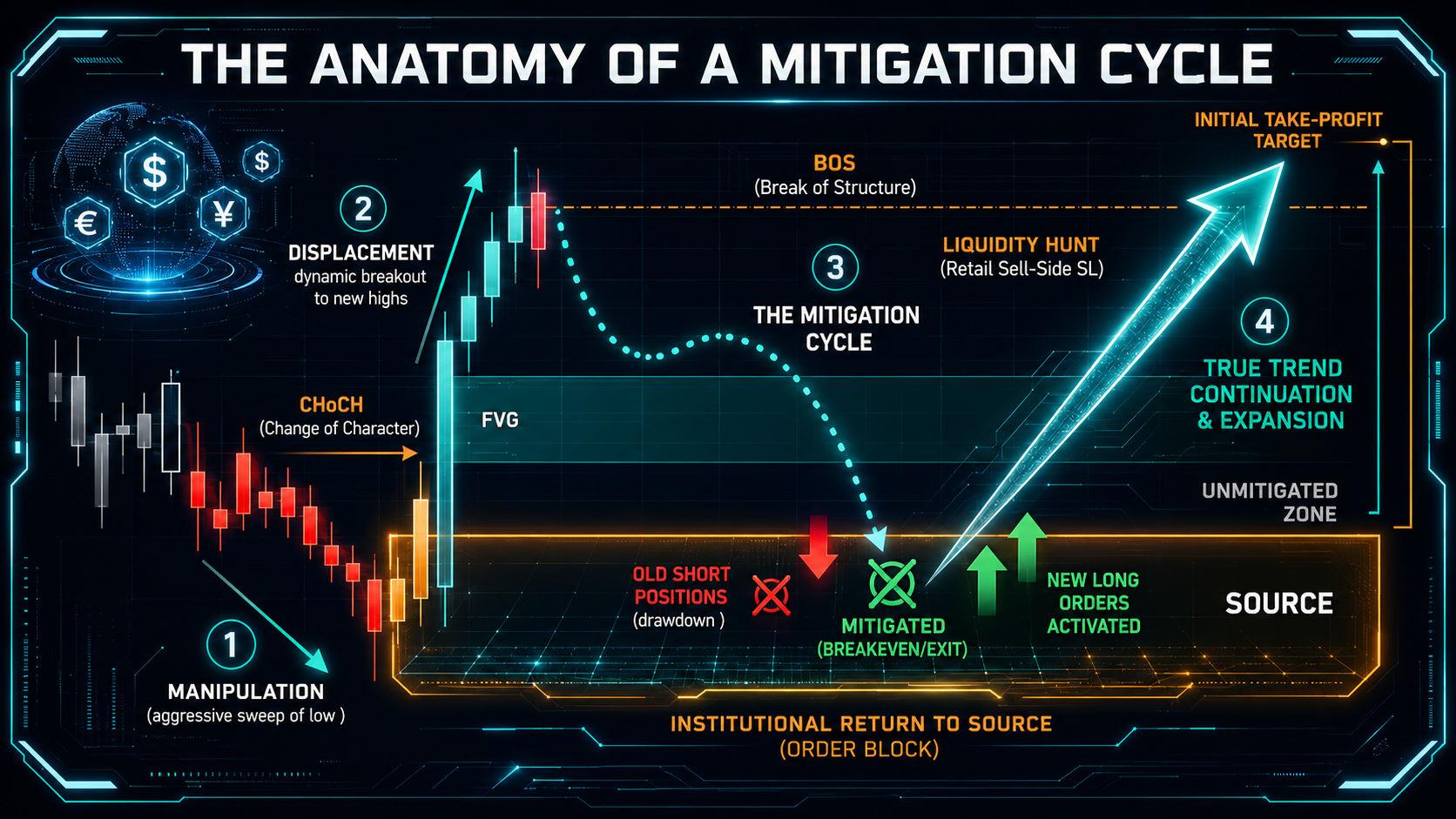
You’ve perfectly identified a structural shift. You caught the Change of Character ($\text{CHoCH}$), mapped out the high-probability order block, and waited for price to move. But instead of a clean continuation, the market aggressively reverses, taps your stop loss, and then rockets toward your initial take-profit target.
If this sounds familiar, you are likely falling victim to the retail trap of chasing the initial expansion rather than waiting for the market to rebalance.
To transition from a retail target into an institutional trader, you must master the mechanics of the Mitigation Cycle. This is the exact technical trigger that tells you when big banks are done manipulating price and are finally ready to let the true trend run.
What is a Mitigation Cycle? (The Institutional “Why”)
To understand mitigation, you have to abandon the retail myth that markets move purely because of “buyers outnumbering sellers.” Institutions operate under strict liquidity constraints. Because their position sizes are so massive, they cannot simply click “buy” or “sell” at market price without causing extreme slippage.
To trigger a massive bullish expansion, an institution must first inject heavy sell volume to drive the market down into a pool of retail stop losses (sell-side liquidity). This engineering of liquidity creates a temporary hedge:
- They are heavily Long from the absolute bottom of the manipulation.
- They are in a significant drawdown on the Short positions they used to push the market down in the first place.
![A high-tech financial chart diagram explaining the Forex "Mitigation Cycle" concept with a dark blue futuristic interface background, featuring a white candlestick line chart, a highlighted gold "[ORDER BLOCK]" zone, and a large white arrow indicating a "[BULLISH EXPANSION]."](https://i0.wp.com/forexbroker500.com/wp-content/uploads/2026/06/MITIGATION-CYCLE-trading-concept-infographic.png?resize=1024%2C559&ssl=1)
A Mitigation Cycle is the process where price returns to the origin of that initial manipulation. The institution pumps price back down to their original entry point to close out their bleeding short positions at breakeven (or minimal loss) while simultaneously activating their remaining buy orders.
Anatomy of an Unmitigated Setup
Before you can trade a mitigation entry, you must identify an unmitigated shadow or order block.
An unmitigated zone is a fresh area of institutional buying or selling that has not been retested by price action since the initial breakout. These areas leave behind clean market inefficiencies, such as Fair Value Gaps ($\text{FVG}$), which act like magnets for future price movement.
The Structural Checklist:
- The Manipulation: A sudden, aggressive sweep of a clean high or low (liquidity hunt).
- The Displacement: A violent break of structure ($\text{BOS}$) in the opposite direction, leaving behind an unmitigated order block.
- The Inefficiency: A visible gap between the candles, signaling that price moved too fast for institutional orders to be fully matched.
⚡ The Execution System Blueprint:
Applying these institutional mitigation rules manually while managing emotional stress is where most traders fail. If you want a fully mapped-out, rule-based execution system built specifically for scaling institutional mechanics, check out the complete FB500 Funding Edge Strategy to systematically clear your chart confusion.
Refining the Entry: High-Timeframe to Low-Timeframe
The secret to maximizing your Risk-to-Reward ($\text{R:R}$) ratio lies in multi-timeframe refinement. While a $1\text{H}$ or $4\text{H}$ chart gives you the macroeconomic directional bias, executing directly on those timeframes requires wide stop losses that kill your percentage gains.
Instead, treat the higher-timeframe unmitigated order block as your Point of Interest (POI).
Step 1: Wait for the POI Tap
Do not place blind limit orders at the open of a $4\text{H}$ order block. Let price naturally gravitate back into the zone, filling the market inefficiency.
Step 2: Drop to the Micro-Timeframe
Once price enters your $4\text{H}$ POI, drop down to the $1\text{M}$ or $5\text{M}$ chart. You are now looking for a miniature replication of the exact same institutional cycle:
- Look for a low-timeframe sweep of liquidity.
- Wait for a decisive low-timeframe $\text{CHoCH}$ accompanied by displacement.
Step 3: Execute on the Low-Timeframe Mitigation
Place your entry at the newly formed $1\text{M}$ or $5\text{M}$ unmitigated order block. Your stop loss can now be safely tucked just outside the micro-structure, turning a generic 30-pip retail stop loss into a hyper-precise 3-to-5-pip institutional stop loss.

Capitalizing on Institutional Mechanics
Mastering the mitigation cycle shifts your entire trading philosophy. You stop guessing where the market might go and start reacting to where big money must return to balance its books.
This mechanical precision provides the exact mathematical edge required to protect capital, maintain tight drawdown limits, and achieve the asymmetric risk profiles necessary to secure corporate backing.
🚀 Secure Your Capital Allocation:
Mastering the mitigation cycle gives you the exact high-probability execution needed to protect capital and hit strict profit targets. Ready to take your trading to an institutional level with massive buying power? Apply this exact edge and secure your capital allocation through Forex Broker 500 Prop Funding today.

No responses yet