
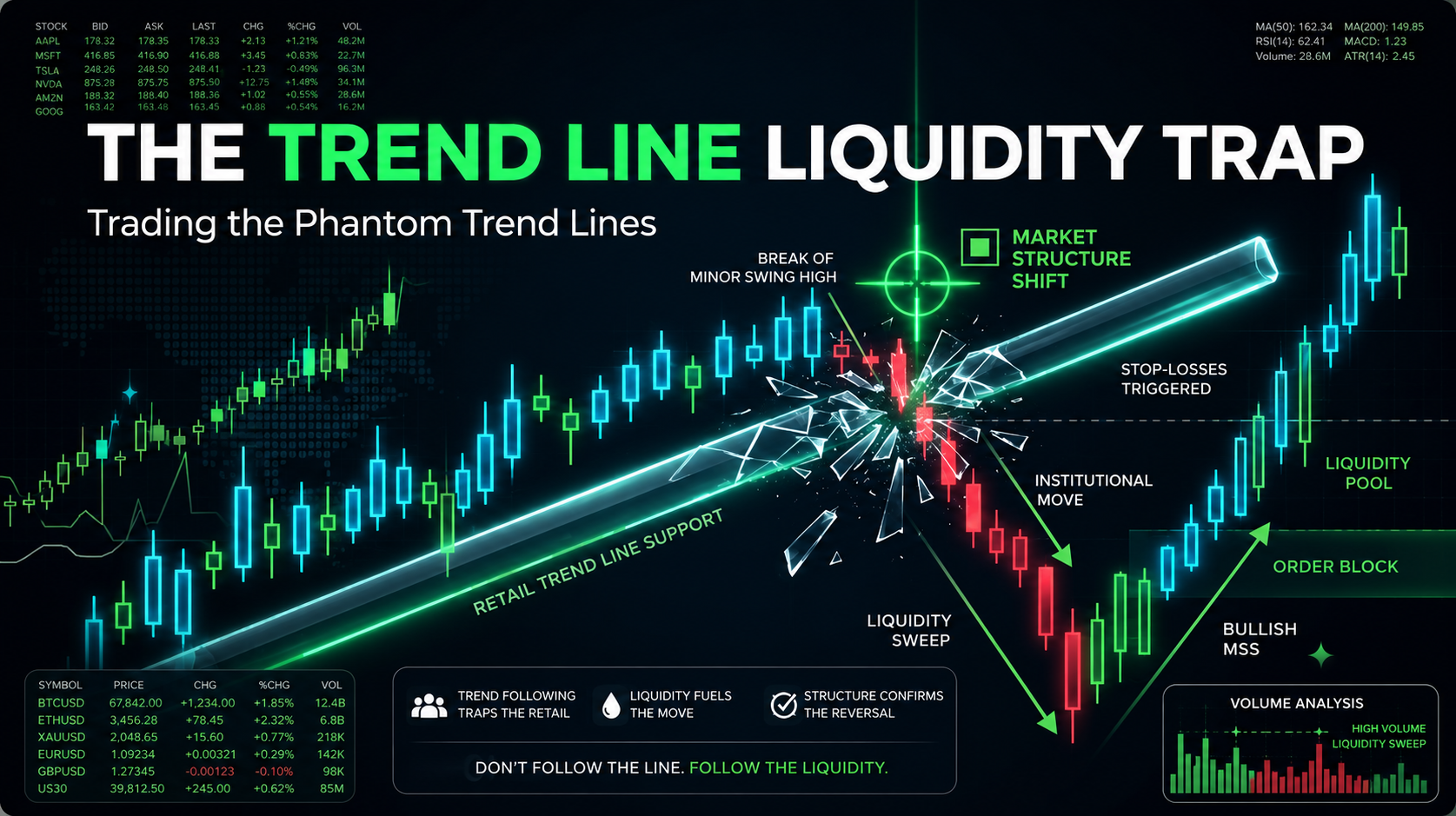
Retail textbooks teach you that a trend line is a diagonal line of support or resistance where price is “supposed” to bounce. They tell you that the more times a trend line is tested, the stronger it becomes.
At Forex Broker 500, we look at the market through an institutional lens. And from that perspective, that classic retail rule is completely backward.
The truth? The more times a trend line is touched, the more dangerous it becomes to trade.
To institutional algorithms, a well-defined retail trend line isn’t a reliable barrier — it is an engineered pool of high-density liquidity waiting to be harvested.
Why Retail Trend Lines Fail: The Mechanics of the Sweep
To understand why traditional trend line trading strategies fail, you have to understand the liquidity dynamics behind them.
When retail traders see a clean trend line forming, they all execute the same playbook:
- They buy or sell on the third or fourth touch.
- They place their stop-loss orders just a few pips below or above that diagonal line.
- As the trend line extends, a massive trailing footprint of stop-losses builds up directly underneath it.

Institutional market makers control massive blocks of volume. To enter or exit large positions without causing massive slippage against themselves, they need an equal and opposite pool of orders. Your stop-loss as a buyer is a market sell order. Therefore, the algorithm purposefully drives price through the trend line to trigger those stops, absorbing your forced sell orders to fill their massive buy positions at a discount.
Once the retail stops are swept and the institutional orders are filled, price immediately reverses and rockets in the direction retail originally expected. It’s not bad luck; it’s an engineered liquidity sweep.
📊 Free Tool Upgrade
Before tracking these algorithmic traps, you need the right tools on your charts to clean up your execution. Skip the default retail settings and download our curated technical toolkit: Get the Top 20 Indicators Free Download to optimize your platform for institutional structure tracking.
The 2026 Upgrade: Trading Phantom Trend Lines
To stop being the liquidity, you must learn to hunt it. Advanced institutional traders look for Phantom Trend Lines. These are historical diagonal retail structures that have already been broken, but still dictate where internal liquidity rests.
Instead of buying at the trend line, we wait for the algorithm to violate it. Here is the step-by-step framework to trade this institutional upgrade:
- Identify the Engineering Phase:
Locate a clean, obvious retail trend line with at least three touches. Do not trade it. Simply monitor it and recognize it as an active liquidity pool.
2. Wait for the Liquidity Hunt (The Sweep):
Wait for price to aggressively break through the trend line. This move is typically fast and volatile, designed to panic retail traders into thinking a breakout is happening while triggering the stop-losses of those trying to trade the bounce.
3. Look for Market Structure Shift (MSS):
Once price breaks the trend line, wait for it to sweep into an institutional key zone (like a higher-timeframe Order Block or an Inversion Fair Value Gap). Look for a sharp rejection on a lower timeframe followed by a displacement candle breaking a recent swing high/low.
4. Enter on the Retest:
Enter your position on the return to the newly created Fair Value Gap (FVG) or Order Block left behind by the displacement move. Your stop-loss is now safely placed below the structural low formed by the liquidity sweep.
The Shift in Mindset: Retail traders use trend lines to find entries. Institutional traders use trend lines to find target zones where everyone else’s stops are sitting.
By shifting your focus to Phantom Trend Lines and waiting for the inevitable sweep, you stop guessing where price will bounce and start trading alongside the algorithms that actually move the market.
Take Your Trading to the Institutional Level
Mastering liquidity concepts like Phantom Trend Lines is the exact edge required to clear steep prop firm targets without violating tight drawdown parameters. If you are ready to stop being the target and start scaling your trading capital systematically, you need a structured framework.
Exclusively for our community, we have packaged these exact institutional mechanics into a step-by-step playbook. Discover the exact process to pass your evaluations, protect your downside, and secure a six-figure allocation with our complete guide: Prop Firm Passing Strategy: FB500 Funding Edge.

No responses yet