
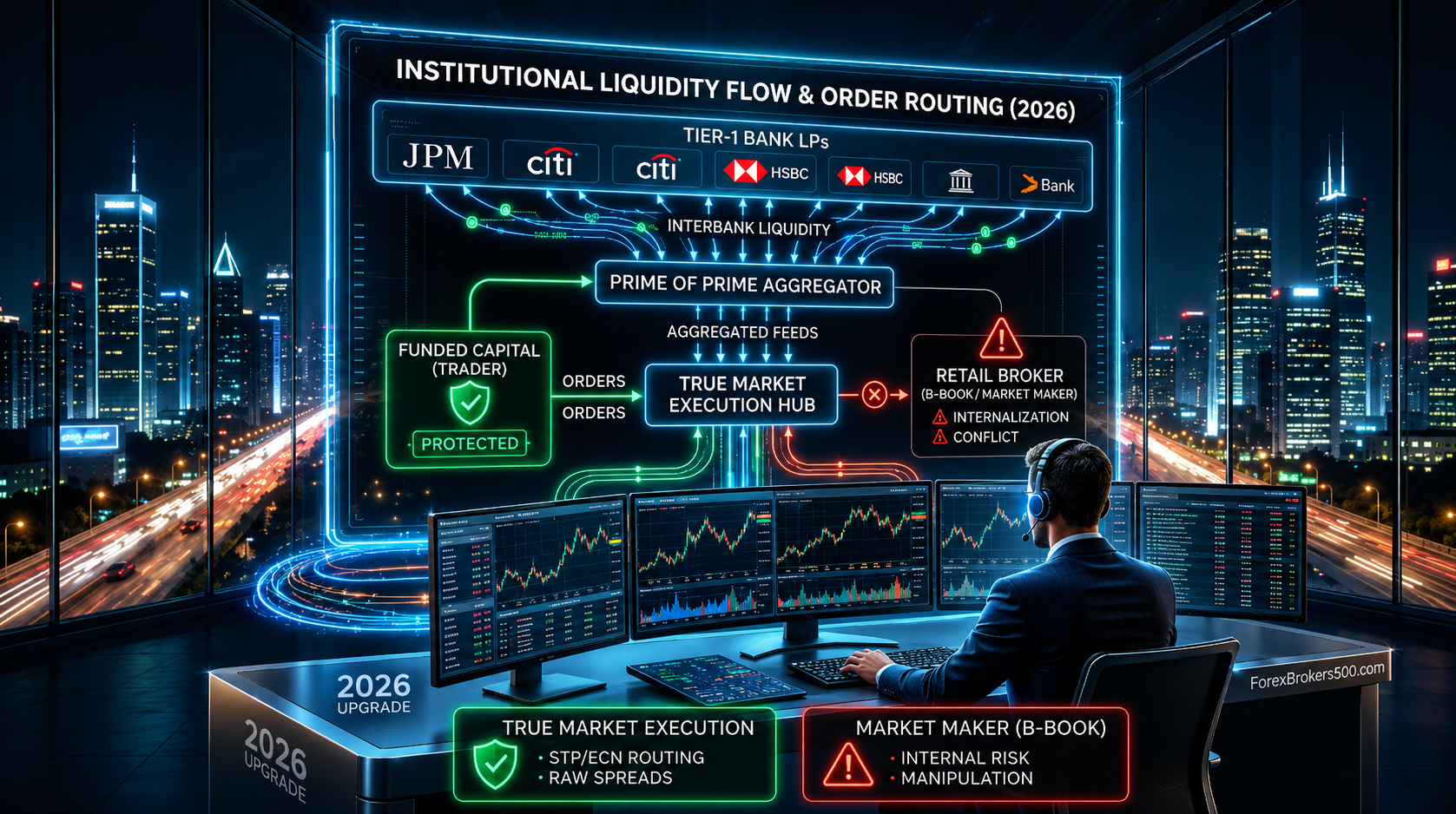
For years, retail traders looking for an honest assessment of broker conditions would search for an InstaForex credibility review. Historically, InstaForex has operated largely as a market maker (B-Book broker), handling execution internally. While this model is common for micro-account retail trading, it introduces a structural conflict of interest.
As trading capital grows—especially in the era of high-scale prop firm funding—understanding how your broker routes orders is no longer optional. It is the direct barrier protecting your capital from systematic slippage and arbitrary execution delays.
To truly evaluate a broker’s credibility, you must look past their marketing and look directly at their Liquidity Providers (LPs). Let’s pull back the curtain on how tier-1 bank liquidity feeds work behind the scenes and how true market execution differs from market-making processing.
The Liquidity Hierarchy: From Interbank to Your Terminal
The retail Forex market does not exist in a vacuum. Every trade you place on your MT4, MT5, or cTrader terminal relies on a hierarchical structure of institutions moving capital.

As shown in the flow above, your order travels from your terminal through a series of bridges. If your broker does not route your order through a legitimate Prime of Prime (PoP) aggregator, your trades never reach the actual Interbank pool.
1. Tier-1 Liquidity Providers (The Interbank Market)
At the very top of the food chain sits the Interbank market. This is a loose network of global investment banks—including JPMorgan Chase, Citibank, HSBC, Barclays, and Deutsche Bank—that trade currencies directly with one another. These institutions transact in massive volumes (typically standard lots in the hundreds or thousands) and offer the tightest, rawest spreads imaginable (often 0.0 pips on majors).
2. Prime of Prime (PoP) Brokers
A retail broker or mid-sized prop firm cannot knock on Citibank’s door and ask to connect an API. The minimum capital requirements to deal with Tier-1 banks are astronomical. Enter Prime of Prime (PoP) brokers. These institutional intermediaries have direct lines of credit with Tier-1 banks, pool their liquidity, and “carve” it up into accessible sizes for retail brokerages.
3. Retail Brokers (STP/ECN vs. Market Makers)
At the bottom tier sit retail brokers. Depending on their business model, they handle your order in one of two ways:
- STP/ECN (A-Book): The broker acts as a pure software bridge. They take your order, match it with the best price available from their Prime of Prime liquidity aggregator, and pass it directly through. They earn money solely on commission or a small markup.
- Market Maker (B-Book): The broker takes the opposite side of your trade. If you buy EUR/USD, the broker sells it to you. They do not route the trade to an external liquidity provider. Your loss is their direct revenue.
B-Book vs. A-Book: How Execution Quality Affects Your Bottom Line
When analyzing a broker like InstaForex, understanding their execution framework explains the trading conditions you experience.
| Feature | A-Book (True Market Execution) | B-Book (Market Maker / Internalisation) |
| Counterparty | An external Tier-1 Bank or LP | The Broker itself |
| Conflict of Interest | None. The broker wants you to trade forever. | High. The broker profits when you lose capital. |
| Execution Speeds | 10ms – 100ms (Subject to network latency) | Instant (but highly subject to artificial delay filters) |
| Slippage | Symmetrical (Can go in your favor or against you) | Asymmetrical (Usually only slips against you) |
| Spreads | Floating (Variable based on real market depth) | Fixed or artificially smoothed |
The Red Flags of Poor Liquidity Routing
If a broker claims to offer “ECN execution” but lacks credibility, they are likely running a hybrid model (B-booking profitable traders while A-booking losers) or utilising lower-tier liquidity providers (Tier-2 banks or shadow market makers) that feature poor order depth.
Look out for these classic execution traps:
1. Asymmetric Slippage
If you limit-order a breakout and consistently experience negative slippage (getting filled at a worse price) but never experience positive slippage (getting filled at a better price), your broker is pocketing the difference. Real market execution routed to tier-1 feeds will naturally result in positive slippage during liquid, fast-moving markets.
2. Systematic Re-quotes
In a true STP environment, re-quotes do not exist. If the price you requested is gone, your trade is filled at the next best available price (market execution). If your platform frequently throws “Re-quote” pop-ups, you are trading on a virtual dealer plug-in designed to protect the broker’s B-book from rapid price shifts.
3. Artificial Spread Widening
During high-impact news releases, spreads naturally widen due to tier-1 banks pulling their liquidity depth. However, if your broker’s spreads widen from 1.0 pip to 15.0 pips and remain elevated for minutes after a minor economic release, they are artificially inflating spreads to trigger stop-losses.
💡 Pro Tip: To audit your broker’s actual execution quality, you need objective tracking tools. Standard platform indicators often lag or fail to show true market volume. To help you spot manipulation and analyze spreads in real-time, you can download ourTop 20 Trading Indicators for Freeto optimize your charts for true institutional-grade analysis.
Why Liquidity Integrity is Paramount for Funded Capital
If you are trading personal capital in a small $1,000 retail account, execution flaws might cost you a few dollars. But if you are managing a $100,000 or $200,000 funded account, minor delays and slippage completely destroy your risk-to-reward ratios.
Prop firm challenges have tight daily drawdown limits (often 5%). If you experience an artificial 2-pip slip on a high-lot trade during an NFP release, that single slip can violate your drawdown rules and lose you your entire funded account. This is why institutional-grade traders demand brokers backed by tier-1 execution.
If you are confident in your strategy and ready to transition away from risking your own hard-earned savings with high-conflict retail market makers, you should be leveraging professional capital. You can explore modern evaluation programs, compare industry-leading brokers, and find the right institutional backing directly on the ForexBroker500 Homepage. Utilising scaled prop capital under true market execution is the ultimate way to protect your personal net worth while scaling your trading business.

No responses yet