
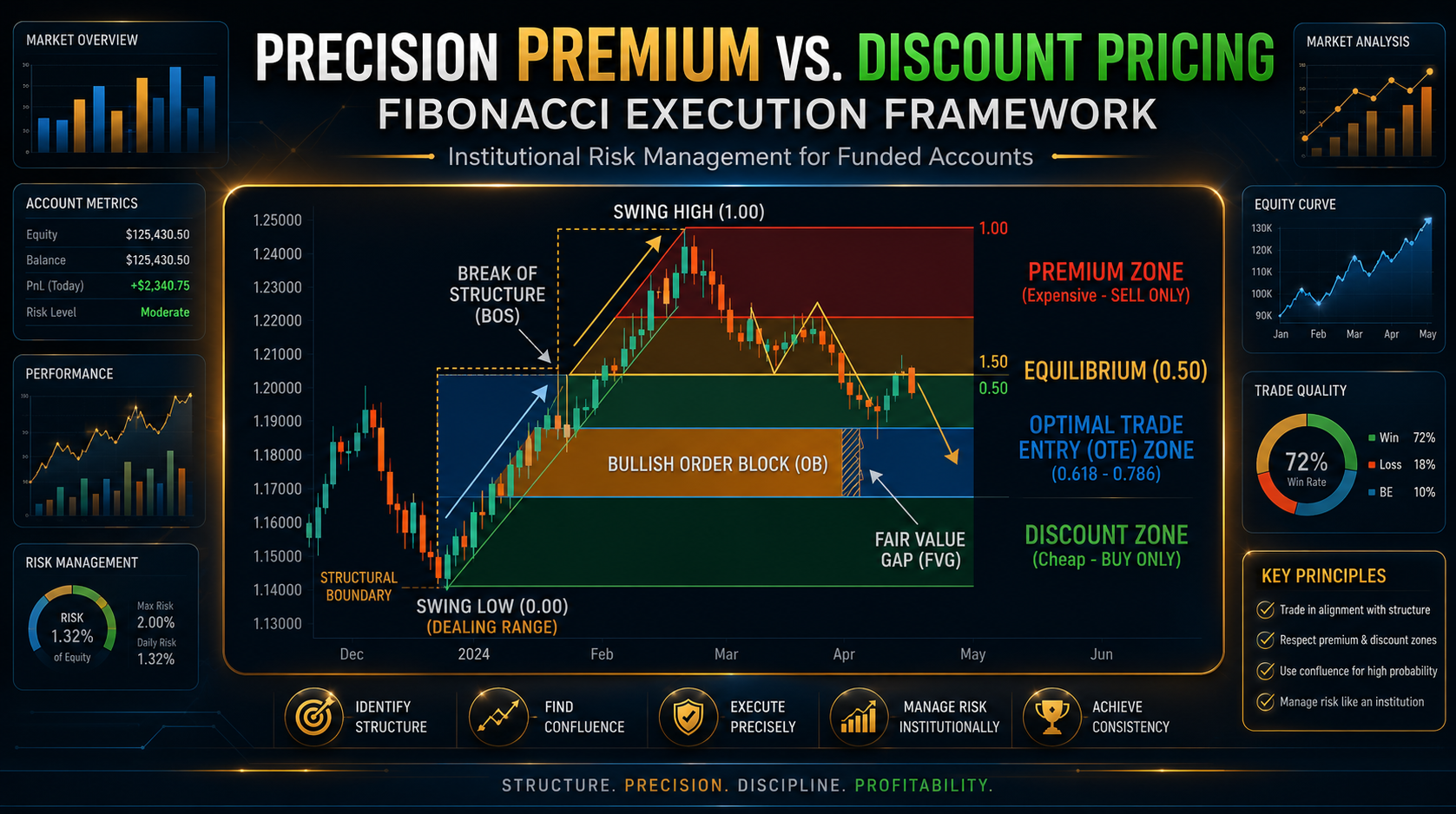
For institutional traders and prop firm risk managers, the Fibonacci tool has nothing to do with market mysticism, “golden ratios,” or predictive magic numbers. Instead, it is a purely mechanical, data-driven utility used to measure whether price is objectively “cheap” (Discount) or “expensive” (Premium) relative to a defined dealing range.
If you are trading a funded account, entering a position too early during a market mitigation cycle is a surefire way to violate your maximum daily drawdown limits. By treating the Fibonacci tool as an operational risk-management filter rather than a predictive crystal ball, you can upgrade standard retail strategies—like basic [fibonacci-money-hacks]—into a rigid framework that prevents over-trading and keeps you on the right side of institutional order flow.
1. Defining the Dealing Range: Identifying Structural Highs and Lows
Before dragging your Fibonacci tool across a chart, you must identify a valid Dealing Range. A dealing range is bounded by a definitive, market-structure-validated swing high and swing low.
- In a Bullish Trend: The dealing range is established after the market creates a clean Break of Structure (BOS) to the upside. The origin of that impulse move becomes your Swing Low, and the temporary point of exhaustion before a retracement begins becomes your Swing High.
- In a Bearish Trend: The dealing range is established after a BOS to the downside. The origin of the drop is your Swing High, and the temporary pausing point is your Swing Low.
The Funded Account Rule: Never draw a Fibonacci grid across minor, intraday noise. If the swing high or swing low hasn’t swept liquidity or broken a minor structure, it is not a valid institutional dealing range boundary.
2. The Equilibrium Line (0.50) as a Strict Operational Filter
Once your dealing range is mapped, the 0.50 level represents Equilibrium—the fair value of that specific market cycle. This line acts as a binary operational filter:
- Premium Zone (Above 0.50): Price is objectively expensive. Absolutely no buying is permitted here. * Discount Zone (Below 0.50): Price is objectively cheap. Leaning on short positions here is strictly forbidden.

Retail traders frequently blow funded accounts because they chase momentum, buying breakout candles inside the Premium zone just as institutional algorithms prepare to drive price downward into a mitigation cycle. By applying this binary filter, you mathematically protect your capital from buying the top or selling the bottom.
3. Mapping the Optimal Trade Entry (OTE) Zone with Institutional Order Blocks
While the 0.50 line is your structural filter, your actual execution matrix lies between the 0.618 and 0.786 Fibonacci levels. This pocket is known as the Optimal Trade Entry (OTE) zone.
However, the OTE zone cannot be traded blindly. To achieve the hyper-precise, high-R:R (Risk-to-Reward) setups required to clear prop firm targets, the OTE zone must align perfectly with underlying institutional footprints:
- Order Block Confluence: Look for a valid bullish order block (the last down-close candle before an upward impulse) or a bearish order block nested directly within the 0.618–0.786 zone.
- Fair Value Gaps (FVG): Ensure there is an unfilled liquidity void or FVG cutting through the OTE zone. Algorithms will naturally pull price deep into this pocket to rebalance the market before expanding outward.
The Execution Protocol
- Bullish Setup: Wait for price to pull back deep into the Discount zone, entering the 0.618–0.786 OTE pocket. Ensure it mitigates a bullish order block. Place your stop-loss safely below the Swing Low (0.00).
- Bearish Setup: Wait for price to rally into the Premium zone, piercing the 0.618–0.786 OTE pocket. Ensure it mitigates a bearish order block. Place your stop-loss safely above the Swing High (1.00).
4. The Path to Funding: Applying Mechanical Execution
To consistently pass prop firm evaluations, you must eliminate emotional bias. Randomly placing trades based on “gut feelings” guarantees failure under strict drawdown parameters. Embracing a purely mechanical framework—where you only execute when price penetrates the OTE zone inside a valid dealing range—is what separates funded traders from the rest.
If you are ready to put this execution framework to the test on a live evaluation with scaling opportunities, reliable payouts, and institutional trading conditions, explore your capital options through premier prop funding via Forex Broker 500.
Need a Complete System to Pass Your Evaluation?
Scaling your risk parameters using premium vs. discount matrix pricing is just one piece of the puzzle. To discover the exact step-by-step blueprint for passing rigorous evaluation phases without breaching your daily loss limits, read our comprehensive guide on the Prop Firm Passing Strategy: FB500 Funding Edge.

No responses yet