
If you have successfully secured funding with a prop firm, you have achieved what only a small percentage of retail traders ever manage. But if you are still trading a single funded account, you are leaving massive leverage on the table—and exposing yourself to an unnecessary single point of failure.
The true path to institutional-scale capital lies in multi-account allocations. By spreading your risk across multiple prop firms simultaneously, you insulate your trading career against sudden rule changes, firm insolvencies, or localised drawdown breaches.
However, scaling capital isn’t as simple as turning on a standard trade copier and walking away. Modern prop firms utilise highly sophisticated algorithmic risk engines designed to flag identical trading activity, latency discrepancies, and unauthorised copy-trading networks.
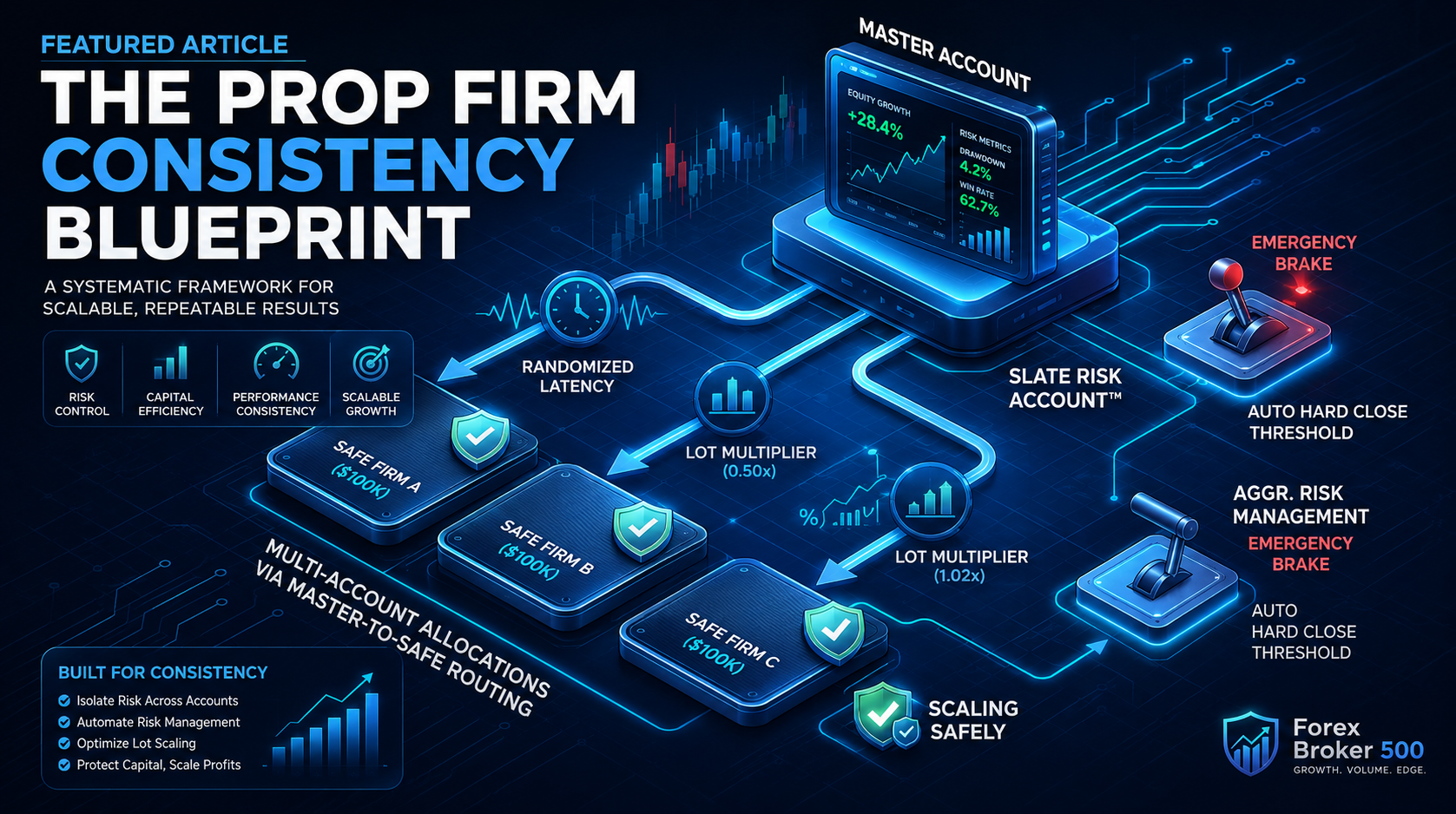
This blueprint breaks down the precise operational mechanics of managing a multi-firm portfolio using master-to-slave routing without triggering automated platform red flags.
1. The Execution Bottleneck: Latency, Slippage, and Trade Data Modification

When you execute a market order on a master account, a trade copier intercepts that signal and transmits it to your slave accounts. While this happens in milliseconds, that tiny window alters your trade execution data in ways that can severely impact your bottom line and account compliance.
The Impact of Multi-Route Latency
Every hop between your master terminal, the copier software, and the slave broker servers introduces latency (the delay in data transmission). Even a 50-millisecond delay can result in your slave accounts’ entries being filled at a slightly worse price, known as slippage.
Over dozens of trades, slippage causes a performance divergence between your accounts. Your master account might hit its profit target perfectly, while your slave accounts lag behind or, worse, breach a strict daily drawdown limit because of an inflated entry price.
Dealing with Execution Order Variations
Most standard copy software sends trades sequentially (Account A, then Account B, then Account C). If market volatility is high during a news release, the third or fourth account in the chain will consistently get the worst fills. To combat this, advanced setups require multi-threaded copiers that broadcast the order to all slave endpoints simultaneously.
📈 Scale Safely Across the Evaluation Phase
Navigating these execution bottle-necks while trying to pass evaluations across different firms requires a proven blueprint. Don’t risk account termination due to sloppy copier configurations. Master the precise framework for handling multi-account setups flawlessly with the FB500 Funding Edge Strategy.
2. Evading Automated Algorithmic Red Flags
The biggest risk in multi-account routing isn’t market direction—it is getting your accounts terminated for violating “identical trading activity” or “IP/device sharing” rules.
Prop firms often restrict traders from executing the exact same trades across multiple accounts if they suspect a third-party account-management service is pulling the strings. If their automated risk engines detect multiple accounts opening the exact same lot sizes at the exact same millisecond down to the micro-pip, those accounts are flagged for instant review or termination.
To scale safely, you must intentionally introduce variance into your trade execution data:
- Randomise Your Entry Latency: Use a trade copier that allows you to inject a deliberate, randomised delay (e.g., between 100 and 500 milliseconds) across your slave accounts. This prevents a synchronised millisecond footprint.
- Vary Your Lot Sizes Slightly: If your master account opens a 10.0 lot position, set your copier settings to apply a fractional multiplier (e.g., 0.98x or 1.02x) on different slave accounts. This ensures your order tickets display unique volume signatures (e.g., 9.8 lots on one firm, 10.2 lots on another).
- Utilise Dedicated VPS Infrastructure: Never run multiple slave accounts from a single local IP address if they belong to different prop firm groups with strict anti-IP matching algorithms. Utilise distinct Virtual Private Servers (VPS) to isolate your digital footprints.
3. Managing Aggregated Risk Across the Funding Pool
When you trade one account, a 2% drawdown is just a 2% drawdown. When you route trades across five $100k accounts, a 2% drawdown on your master terminal means you are down $10,000 across your aggregated pool in real-time.
Managing a multi-account portfolio requires a shift from individual account psychology to portfolio risk management.

Preventing Correlated Drawdown Breaches
Because different prop firms calculate their daily drawdowns differently—some based on balance at market close, others based on equity highs in real-time—a single volatile market spike can safely pass through one firm but trigger a daily breach at another.
To protect your funding pool, you must implement an aggregated emergency brake. If your collective floating loss across all platforms approaches a specific threshold (e.g., 3.5% instead of the standard 5% maximum), your copier system should automatically trigger a hard close on all open positions across every terminal.
The Bottom Line: Infrastructure is Everything
Scaling into multi-firm management is the ultimate evolution of a professional retail trader. But your strategy is only as robust as the technical environment backing it up. To route signals effectively without execution lag, severe slippage, or platform friction, your underlying trading foundation must be built on institutional-grade conditions.
For professional-tier spreads, ultra-low-latency execution architecture, and a trading infrastructure built to handle advanced setups smoothly, secure your edge directly at Forex Broker 500.

No responses yet