
Most traders spend years searching for the perfect indicator or strategy, but the truth is — profitable trading often comes down to understanding price behavior and liquidity.
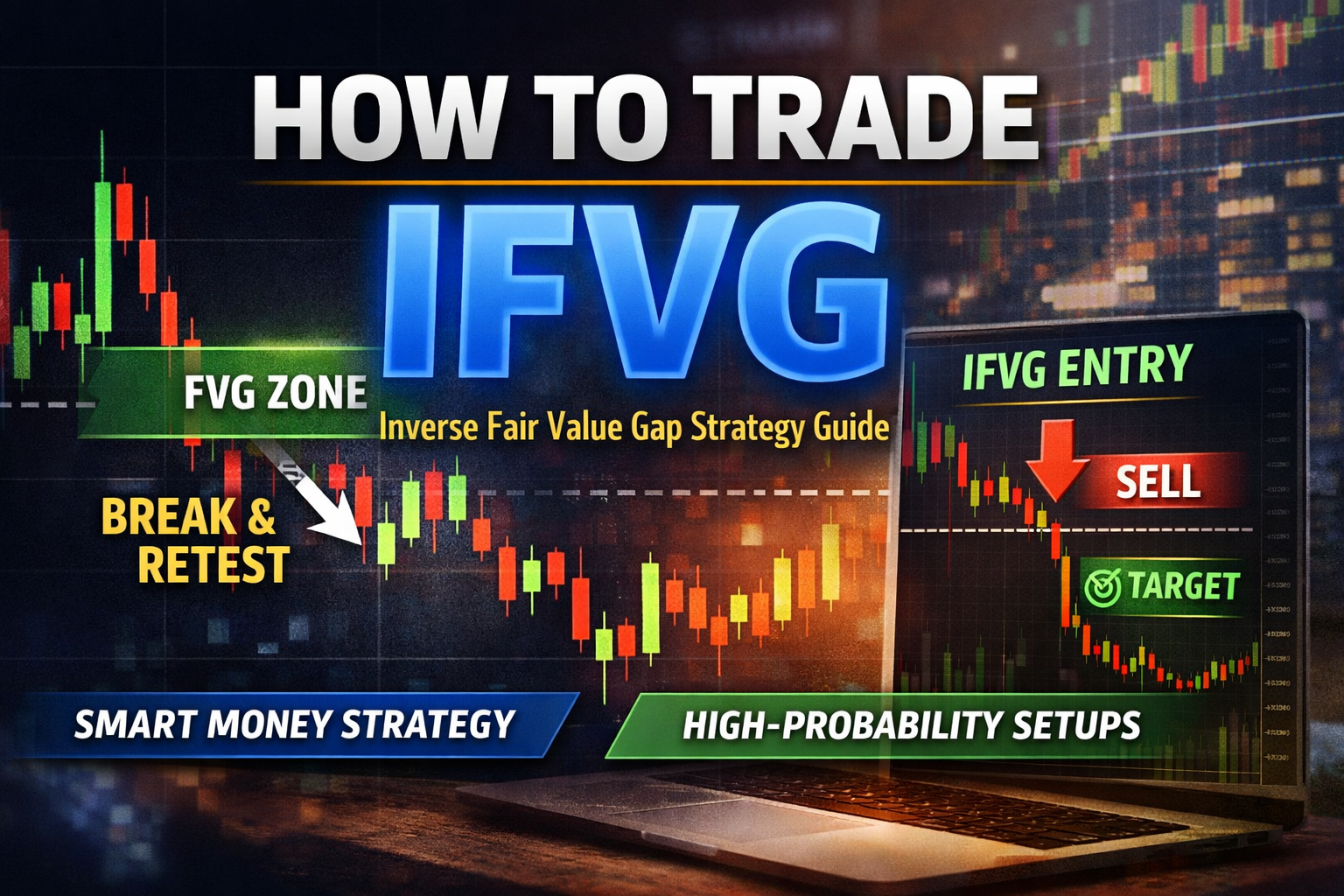
One concept that has become increasingly popular among professional traders is the Inverse Fair Value Gap (IFVG). When used correctly, this strategy can help you identify high-probability entries, avoid chasing trades, and align with institutional order flow.
In this guide, you’ll learn exactly how to trade IFVG, how to identify it, when to enter, and why it works.
What Is an IFVG in Trading?
Before understanding IFVG, you need to understand a standard Fair Value Gap (FVG).
A Fair Value Gap is a price imbalance that occurs when the market moves aggressively in one direction, leaving a gap between candles where little trading took place. These gaps often act as areas price returns to rebalance.
An Inverse Fair Value Gap (IFVG) forms when:
- Price breaks through a fair value gap
- Returns to retest it from the opposite side
- Uses it as a reaction zone
In simple terms:
The imbalance flips its role.
This is similar to support turning into resistance — but with deeper institutional logic behind it.
Why IFVG Works (Institutional Logic)
Markets move because of orders, not indicators.
When price breaks through a fair value gap:
- Traders positioned in the original direction become trapped
- Stop losses accumulate
- Liquidity builds
When price returns to that zone, those trapped traders exit or get stopped out, which fuels momentum in the opposite direction.
That’s why IFVG setups often produce strong reactions — they’re driven by liquidity and order flow, not guesswork.
How to Identify an IFVG Step-by-Step
Finding an IFVG setup is simple once you train your eyes. Follow this checklist:
Step 1 — Identify a Fair Value Gap
Look for a strong impulsive move where price leaves an imbalance between candles.
Typically, this appears as a three-candle formation:
- Candle 1 high
- Candle 2 large impulse
- Candle 3 low not overlapping candle 1
That gap is your FVG.
Step 2 — Wait for a Break Through the Zone
Do not trade immediately.
You want price to break through the FVG with momentum. This confirms that the original imbalance has failed.
This step is critical — without the break, it is not an IFVG.
Step 3 — Wait for Price to Return
Patience is where most traders fail.
After breaking the zone, price will often return to retest it. This is where the opportunity forms.
Step 4 — Look for Confirmation
Never enter blindly.
Valid confirmations include:
- rejection wicks
- strong engulfing candle
- market structure shift
- lower timeframe entry signal
No confirmation = no trade.
IFVG Entry Strategy
Here’s how execution works in real trading.
Sell Setup Example
- Bullish FVG forms
- Price breaks below it strongly
- Price returns to zone
- Bearish confirmation appears
👉 Enter sell position
Stop loss → above zone
Take profit → previous low or liquidity level
Buy Setup Example
- Bearish FVG forms
- Price breaks above it
- Price returns to zone
- Bullish confirmation appears
👉 Enter buy position
Stop loss → below zone
Take profit → previous high or liquidity area
Best Timeframes to Trade IFVG
IFVG works on multiple timeframes, but the best combinations are:
- Higher timeframe (H1–D1) → direction bias
- Lower timeframe (M5–M15) → entry confirmation
Professional traders often mark zones on higher timeframes, then drop down to refine entries.
Common IFVG Trading Mistakes
Most beginners fail with this strategy because they rush the process.
❌ Entering Without Confirmation
The zone is an area of interest, not a signal.
❌ Trading Every FVG
Not all imbalances matter. Focus on strong impulsive moves only.
❌ Ignoring Market Structure
Always align with trend direction or structure shifts.
❌ Overtrading
Quality setups matter more than quantity.
Pro Tips to Improve IFVG Accuracy
If you want to increase your win rate, apply these professional tips:
✔ Trade during high-volume sessions (London or New York)
✔ Combine IFVG with liquidity zones
✔ Wait for market structure confirmation
✔ Avoid trading during low volatility hours
✔ Always use risk management
Consistency comes from discipline, not prediction.
📊 Trade IFVG With Precision (Recommended Tool)
If you want cleaner setups and faster chart analysis, many traders use professional tools to confirm entries.
The VIP Indicator is popular among traders because it:
✔ Detects high-probability zones automatically
✔ Works on forex, gold, crypto, and indices
✔ Saves chart time
✔ Helps confirm smart money setups
Using the right tools doesn’t replace skill — it enhances it.
IFVG vs Regular FVG
Regular FVG
- Used for continuation trades
- Price returns and continues trend
IFVG
- Used for reversal or reaction trades
- Zone flips role
Understanding both gives you a complete view of market imbalance behavior.
Who Should Use the IFVG Strategy?
This strategy is ideal for:
- price action traders
- smart money traders
- intraday traders
- scalpers
- swing traders
If you want structured entries instead of guessing, IFVG is worth mastering.
Most traders draw zones manually. Professionals automate it.
Final Thoughts — Master Timing, Not Just Strategy
Learning how to trade IFVG can dramatically improve your trade quality because it forces you to wait for confirmation and trade around liquidity.
Most traders fail because they chase trades.
Professionals wait for price to come to them.
If you want to improve faster, study market behavior — not indicators.
🚀 Start Trading Like a Funded Trader
If your goal is to trade professionally and access larger capital, start here:
This is where traders learn, prepare, and get access to funding opportunities.

No responses yet