
Imagine catching a perfect, textbook liquidity sweep on GBP/JPY. You click “Buy” with a heavy lot size, only to watch your platform freeze for three agonizing seconds. By the time your order fills, you are down 4 pips in “latency tax”—instantly sabotaging your risk-to-reward ratio before the trade even moves.
In modern, high-volatility markets, using outdated or poorly optimized software isn’t just annoying; it is actively costing you money.
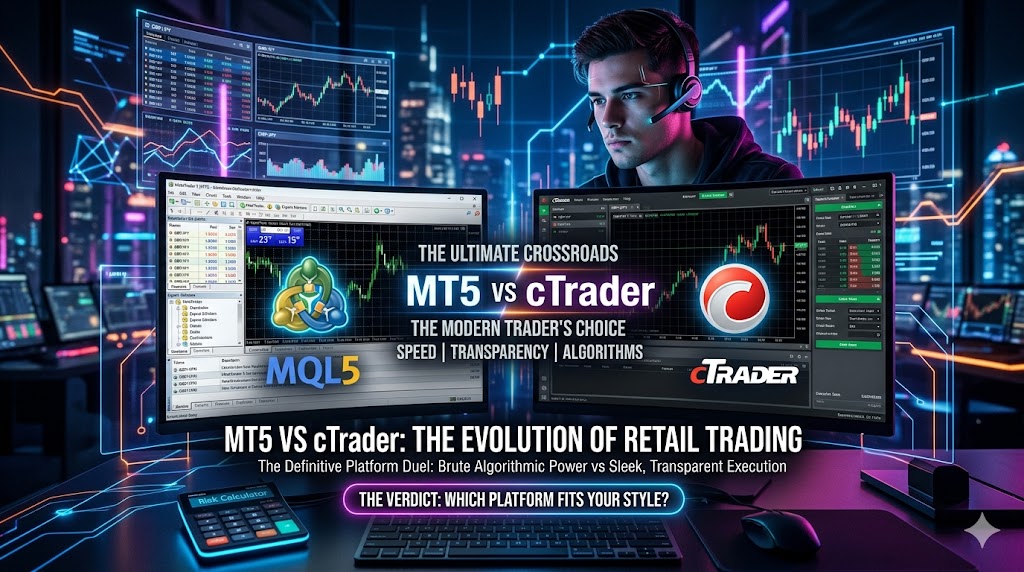
With the retail space aggressively shifting away from legacy platforms like MT4, intermediate traders are faced with a definitive crossroads: MetaTrader 5 (MT5) or cTrader. One dominates the global marketplace with brute algorithmic power, while the other offers a sleek, hyper-transparent execution cockpit.
But which one actually protects your capital and aligns with your execution style? Let’s strip away the broker marketing fluff and look at the raw data.

MT5 vs. cTrader: Specifications Side-by-Side
Before diving into the mechanics, let’s look at the baseline technical architecture of both environments to see how they handle your data and orders.
| Feature | MetaTrader 5 (MT5) | cTrader |
| Primary Trading Model | Market Maker / STP / ECN | Native ECN / STP |
| Interface Style | Traditional, Multi-window | Modern, Streamlined, Fluid |
| Native Timeframes | 21 | 54 (Includes custom ticks) |
| Programming Language | MQL5 (C++ based) | C# (.NET framework) |
| Depth of Market (DoM) | Basic (Separate view window) | Native Level II (Standard, Price, VWAP) |
| Risk Calculator | Third-party plugin required | Native (Automatic risk-to-reward & dollar values) |
Core Battleground 1: Charting Engine & User Interface Design
Your platform is your office. Spending 8 hours a day staring at a cluttered, unresponsive interface ruins your psychological edge and slows down your execution.
MetaTrader 5: Built for Functional Power Users
MT5 retains the classic, rugged Windows-style aesthetic of its predecessor, MT4. It is incredibly functional, stable, and light on CPU usage. It allows you to split profiles and offers 21 timeframes. However, out of the box, it can feel clinical and visually dated.
Its true power isn’t native—it lies in the MQL5 Marketplace. If you don’t like the default look or features, you can buy or download thousands of custom-made indicators and layout tweaks to completely overhaul your workspace.
cTrader: Built for Modern Fluidity
cTrader feels like a platform built in the modern era for modern traders. Its interface is highly intuitive, featuring fluid multi-screen support that allows you to detach charts with a single click.
For technical analysis purists, cTrader is an absolute dream. It offers a staggering 54 timeframes and over 70 built-in indicators. Whether you trade 7-minute blocks or custom tick charts to filter out market noise, cTrader handles it natively without requiring external downloads.
Core Battleground 2: Order Execution Speed and Market Transparency
How your order goes from your screen to the interbank market determines your slippage.
How MT5 Handles Order Routing
MT5 was engineered as a multi-asset engine, supporting both netting (institutional) and hedging (retail) order models. When paired with a quality broker’s local Virtual Private Server (VPS), its local execution speeds are blindingly fast. However, MT5 is a “broker-dependent” engine. Brokers can heavily customize the backend, meaning execution transparency can vary wildly from one broker to another.
How cTrader Maximizes Native ECN Transparency
cTrader was built from the ground up for Straight-Through Processing (STP) and Electronic Communication Network (ECN) environments. Spotware (the creator of cTrader) keeps tight control over the platform architecture, meaning brokers cannot manipulate execution speeds or price feeds easily.
More importantly, cTrader places Level II Depth of Market (DoM) at the absolute center of the experience. It shows you exactly how much liquidity is available at different price levels in real time. If you are a heavy-lot scalper, you can see your potential slippage before you click buy.
Core Battleground 3: Automated Trading: EAs vs. cBots
If you plan to code algorithms, build trading bots, or run automated scanners, the underlying code framework changes your entire workflow.
- The MT5 MQL5 Advantage: MT5 is the undisputed king of automated trading volume. MQL5 is a high-performance, object-oriented language based on C++. The built-in Strategy Tester supports multi-threaded optimization and real historical tick data. If you want a plug-and-play solution, the MQL5 library features over 25,000 ready-made Expert Advisors (EAs).
- The cTrader C# Advantage: cTrader automates strategies using cBots built on C#—a globally recognized, industry-standard programming language. For developers, writing clean code using the .NET framework is an absolute dream compared to learning proprietary trading languages. The trade-off? The community library is much smaller, meaning you will likely need to build your code from scratch or hire a specialized freelancer.
Native Risk Management: The Hidden Edge
One of cTrader’s most massive modern advantages is its native risk management overlay.
On MT5, calculating your exact position size based on your account balance requires manual math, an external website calculator, or a custom script. On cTrader, when you drag your Stop Loss or Take Profit lines on the chart, the platform automatically displays your risk in exact dollar amounts, percentage of equity, and your precise risk-to-reward ratio before you open the position.
The Verdict: Which Platform Fits Your Style?
Choose MetaTrader 5 If:
- You rely heavily on pre-built automated trading robots (EAs) or indicators from a massive marketplace.
- You want an ecosystem backed by decades of community forum data, troubleshooting threads, and endless freelance coders.
- You value maximum broker flexibility—nearly every institutional and retail broker on earth supports MT5 infrastructure.
Choose cTrader If:
- You are a precision manual day trader, intraday scalper, or trade heavily around high-impact news.
- You demand absolute order transparency and want direct market access views via Level II DoM.
- You are a software developer who prefers coding your algorithms in standard C# rather than specialized trading scripts.
Take Your Execution to the Next Level
Choosing the right platform is only half the battle; you still need a liquidity provider that can deliver raw spreads and lightning-fast execution routing.
If you want to experience institutional-grade execution speeds, ultra-low spreads, and seamless integration with the industry’s best trading tools, open a live account today.
👉 Experience Precision Trading Environment with Our Recommended Broker Partner

No responses yet