
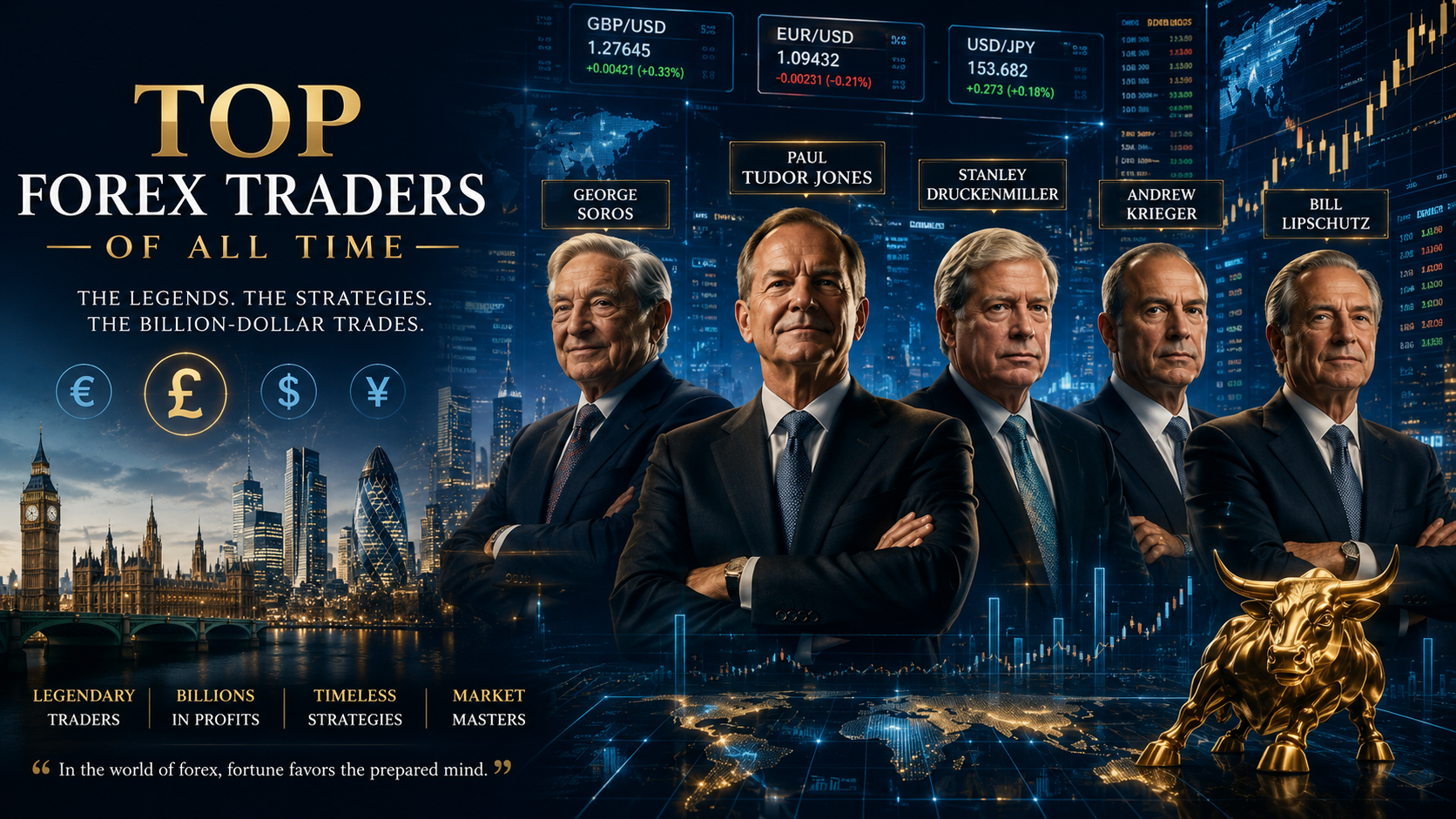
The Greatest Forex Traders of All Time — And the Secrets Behind Their Billion-Dollar Trades
Forex trading has created some of the most legendary investors in financial history. While millions of traders enter the markets hoping for success, only a handful have achieved iconic status through extraordinary profits, discipline, and market insight.
These traders didn’t rely on luck. They mastered psychology, risk management, macroeconomics, and trading strategy at the highest level.
In this guide, we explore the top forex traders of all time and the lessons modern traders can learn from them.
Why Legendary Forex Traders Matter
Studying successful traders helps aspiring forex traders understand:
- Risk management
- Trading psychology
- Market timing
- Fundamental analysis
- Technical analysis
- Long-term consistency
The world’s best traders approach the market differently, but they all share one common characteristic:
Discipline.

1. George Soros
The Man Who Broke the Bank of England
George Soros is arguably the most famous forex trader in history.
He became legendary in 1992 after making one of the greatest currency trades ever recorded during the Black Wednesday.
Soros believed the British pound was overvalued and vulnerable. He placed a massive short position against the pound sterling.
The result?
- Over $1 billion profit in a single day
- The British pound collapsed
- The UK withdrew from the European Exchange Rate Mechanism
This historic trade earned Soros the nickname:
“The Man Who Broke the Bank of England.”
Key Lesson from George Soros
Successful traders are willing to act decisively when conviction and market analysis align.
Trading Style
- Fundamental analysis
- Macro trading
- Aggressive position sizing
- High conviction trades
Learn How Major Currency Moves Create Trading Opportunities
Want to understand how professional traders analyze currencies like GBP/USD?
Forex Broker 500 helps traders learn market structure, trend analysis, and forex fundamentals used in real-world trading.
2. Paul Tudor Jones
The Trader Who Predicted the 1987 Market Crash
Paul Tudor Jones is one of the most respected macro traders in financial history.
He founded Tudor Investment Corporation and became famous after accurately predicting the 1987 stock market crash.
Jones reportedly generated around $100 million from the event.
Unlike emotional traders, Jones focused heavily on:
- Capital preservation
- Risk control
- Macro trends
- Market sentiment
Key Lesson from Paul Tudor Jones
Protecting capital is more important than chasing profits.
Trading Style
- Macro trading
- Trend following
- Fundamental analysis
- Strict risk management
3. Stanley Druckenmiller
The Master of Consistency
Stanley Druckenmiller worked closely with George Soros and helped manage the famous Quantum Fund.
He is widely respected for his consistency and ability to adapt to changing market conditions.
Druckenmiller focuses on:
- Economic trends
- Central bank policy
- Market momentum
- Position management
Unlike many traders, he emphasizes staying flexible rather than becoming emotionally attached to market opinions.
Key Lesson from Stanley Druckenmiller
Great traders know when to change their minds.
Trading Style
- Macro analysis
- Momentum trading
- Flexible market positioning
- Strong risk management
Build a Smarter Trading Mindset
The best traders don’t just predict markets — they manage risk intelligently.
Discover premium trading education and practical forex insights with Forex Broker 500.
4. Andrew Krieger
The Trader Who Attacked the New Zealand Dollar
Andrew Krieger became famous after the 1987 financial crash while working at Bankers Trust.
He believed the New Zealand dollar was heavily overvalued and placed an enormous short trade against it.
His trade reportedly generated hundreds of millions in profits.
Krieger became known for:
- Bold market positioning
- High confidence
- Short-term opportunities
- Aggressive execution
Key Lesson from Andrew Krieger
Market opportunities often appear during periods of panic and volatility.
Trading Style
- Short-term macro trading
- Volatility trading
- Aggressive speculation
5. Bill Lipschutz
The Sultan of Currencies
Bill Lipschutz is considered one of the greatest currency traders ever.
While working at Salomon Brothers, he reportedly generated hundreds of millions in forex profits.
Unlike traders who rely purely on technical indicators, Lipschutz focused heavily on:
- Market psychology
- Sentiment
- Risk control
- Timing
Key Lesson from Bill Lipschutz
The market is driven by human behavior as much as economic data.
Trading Style
- Technical analysis
- Sentiment analysis
- Position management
- Risk-adjusted trading
Common Traits Shared by Elite Forex Traders
Although their strategies differ, these legendary traders share several important characteristics.
1. Risk Management
They protect capital aggressively.
2. Emotional Discipline
They avoid emotional decision-making.
3. Patience
They wait for high-probability setups.
4. Adaptability
They adjust to changing market conditions.
5. Continuous Learning
They constantly improve their knowledge and strategies.
What Modern Traders Can Learn From Them
Most beginner traders focus too much on indicators and not enough on psychology and risk management.
The world’s best traders understand that:
- Losing trades are normal
- Risk management is everything
- Consistency beats gambling
- Patience creates opportunities
- Discipline matters more than excitement
Ready to Trade Like a Professional?
Forex success starts with education, discipline, and strategy.
Join Forex Broker 500 to learn trading concepts, market analysis, and practical forex knowledge designed for modern traders.
Final Thoughts
The top forex traders of all time became legends not because they avoided losses, but because they mastered risk, psychology, and market behavior.
From George Soros’ historic pound trade to Paul Tudor Jones’ crash prediction, these traders proved that success in forex comes from preparation, discipline, and strategic thinking.
For aspiring traders, their stories offer more than inspiration — they provide timeless lessons that still apply in today’s forex markets.

No responses yet