
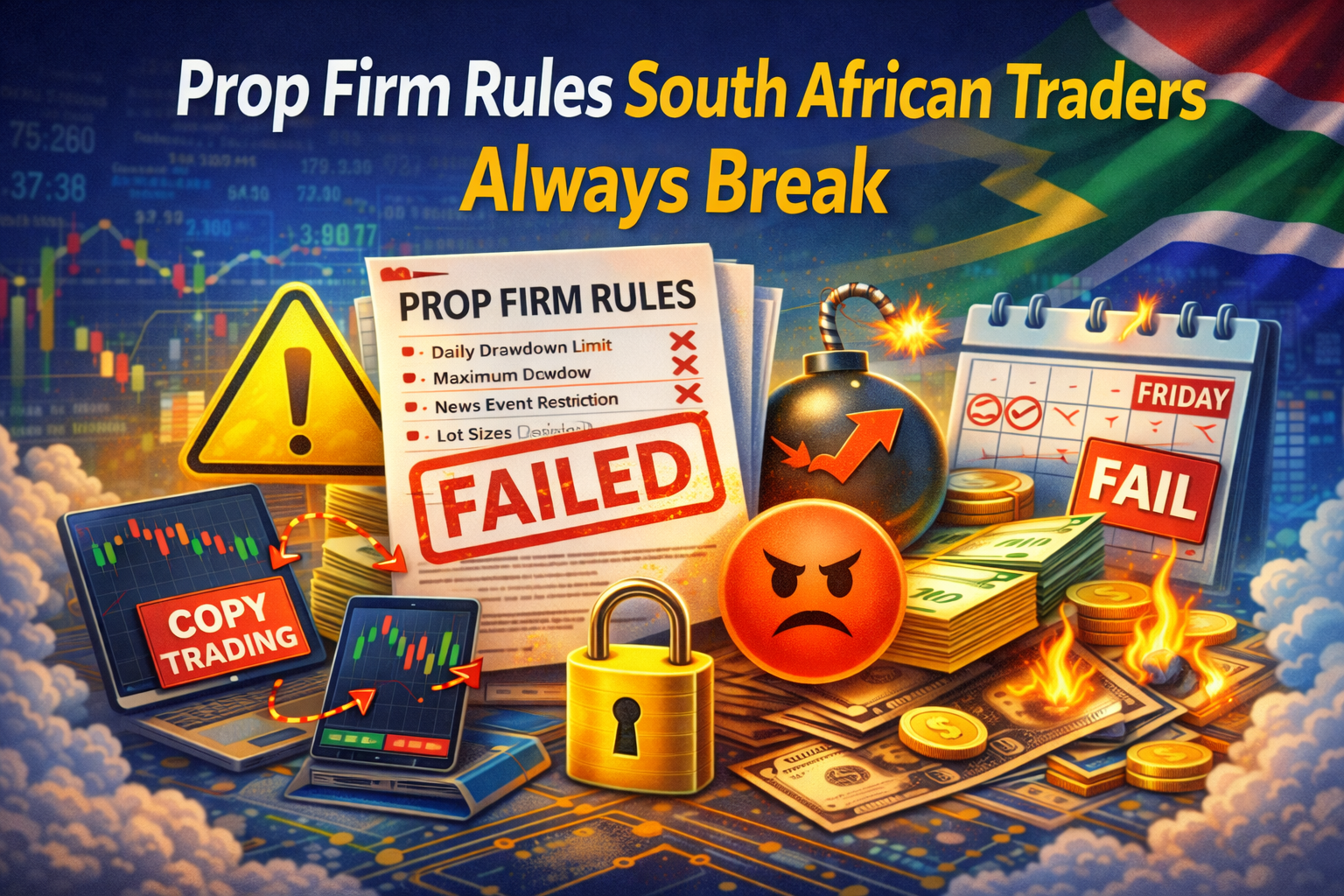
Prop firm challenges look simple on the surface — follow rules, hit profit target, get funded. But many South African traders fail not because they lack skill, but because they unknowingly break key prop firm rules.
Most rule violations happen silently. You don’t even realize you broke them until your account is disqualified.
Understanding these rules — and how traders accidentally violate them — can dramatically increase your chances of passing.
Rule #1 — Daily Drawdown Limit Violations
This is the #1 reason traders fail.
Most prop firms have a daily loss limit (for example 5%). This includes:
- Floating losses
- Closed trades
- Overnight positions
Many traders think only closed trades count. That mistake alone fails thousands of accounts every month.
Rule #2 — Maximum Overall Drawdown
Even if you pass daily limits, you can still fail the challenge if total loss exceeds the maximum drawdown.
Example:
Start Balance: $100,000
Max Drawdown: 10%
If equity drops below $90,000 at any point — you fail instantly.
Rule #3 — Trading During Restricted News Events
Some prop firms prohibit trading during:
- High-impact news events
- NFP releases
- CPI announcements
Placing trades during restricted times can void your account — even if the trade wins.
Rule #4 — Lot Size Inconsistency
Suddenly increasing lot size after losses is considered reckless risk behavior by many firms.
Example violation:
- Trading 0.5 lots normally
- Suddenly trading 5 lots
This can trigger risk flags or rule breaches.
Rule #5 — Holding Trades Over Weekend
Many prop firms restrict weekend holding due to market gap risk.
If your trade stays open past Friday close, your account can be disqualified.
Rule #6 — Copy Trading or Account Sharing
Prop firms strictly prohibit:
❌ Sharing account login
❌ Copy trading services
❌ EA mirroring between accounts
Even logging in from multiple IP addresses can trigger a violation.
Rule #7 — Overleveraging
Leverage is allowed — but abusing it is not.
Using maximum leverage repeatedly signals gambling behavior. Some firms will terminate accounts even if rules weren’t technically broken.
Why South African Traders Break These Rules More Often
Common reasons include:
- Rushing to pass challenge quickly
- Lack of rule education
- Following social media trading signals blindly
- Trading emotionally after losses
Most traders focus only on profit targets and ignore rule compliance.
How Funded Traders Stay Rule-Compliant
Professional funded traders use a structured approach:
✔ Trade smaller position sizes
✔ Track daily loss manually
✔ Avoid news events
✔ Set strict stop losses
✔ Follow written plan
Rule discipline is what separates funded traders from failed ones.
Pro Tip — The 50% Rule
Many experienced traders only risk 50% of the allowed drawdown.
If daily drawdown = 5%
They risk max = 2.5%
This creates a safety buffer that prevents accidental violations.
Signs You Might Break Rules Soon
Watch out for these warning signs:
⚠ Increasing lot size emotionally
⚠ Trading after hitting loss limit
⚠ Ignoring stop losses
⚠ Trying to “recover losses fast”
If you notice these habits, stop trading immediately.
Final Thoughts
Prop firm rules aren’t there to restrict you — they exist to test discipline.
Most traders fail not because they’re bad traders…
but because they’re bad rule followers.
Master the rules → Pass the challenge → Get funded.
👉 Want prop firm comparisons, funding strategies, and pass-rate secrets used by disciplined traders?
Visit ForexBroker500.com — your hub for smart trading education.

2 Responses
Spot on about daily drawdown violations — that’s exactly what killed my first attempt at a prop firm. The rules are so different between firms that a generic EA won’t cut it. I ended up using Ratio X EA Generator to build a custom bot that respects each firm’s specific daily loss limit and lot sizing rules, and it saved me from blowing another account. The AI handles the MQL5 code generation so I can focus on the strategy logic instead of debugging syntax. Have you found that firms with stricter drawdown rules actually require shorter timeframe entries, or is that just my experience?
That is a massive realization. Managing that daily drawdown buffer is what separates funded traders from chronic restarters. Standard out-the-box EAs completely fall apart here because they don’t factor in broker-specific spreads, commissions, or rollover spikes. Using an AI generator to hardcode those limits into your MQL5 logic is a brilliant way to enforce mechanical discipline.To answer your question: You are spot on. Stricter drawdowns structurally force you into lower timeframes. Here is why:Tight Stop Losses: If a firm allows a tiny daily loss limit, your risk per trade must be minuscule (e.g., $0.25\%$). To get a meaningful lot size out of that, you need a tight physical stop (in pips). You can’t easily run a 5-pip stop on a 4H chart; you have to drop to the 1M or 5M to find structural invalidations that tight.Reduced Exposure: Higher timeframes mean holding trades longer, exposing you to overnight swaps or news spikes that can breach a strict daily limit on a floating basis. Lower timeframes let you get in, hit a target, and get out before the daily reset.Out of curiosity, when you adapted your bot to those rules, did you switch to a pure scalping model on the 1M/5M, or are you just using the lower timeframes for precision entries based on a higher-timeframe bias?