
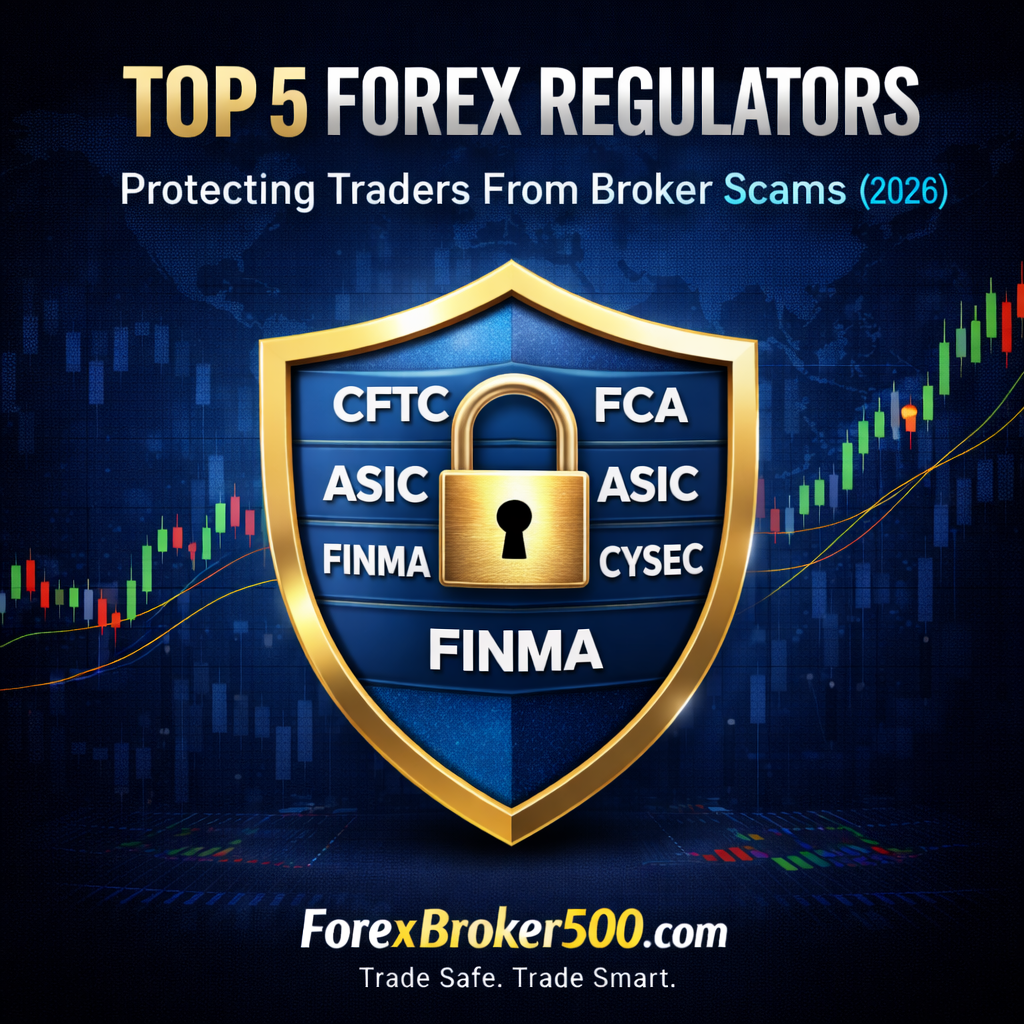
Forex trading is growing rapidly across Africa, Asia, Europe, and the Americas.
But with opportunity comes risk.
Every year, traders lose millions of dollars to:
- Unregulated brokers
- Fake prop firms
- Withdrawal restrictions
- Price manipulation
- Broker shutdown scams
The only real protection you have is regulation.
In this guide, we break down the Top 5 Forex Regulators that protect traders globally and ensure brokers follow strict financial rules.
If you’re serious about protecting your trading capital, this article is a must-read.
And if you want structured broker education and safety insights, ForexBroker500.com provides resources to help traders choose wisely.
Why Forex Regulation Matters
A regulated broker must:
✔ Keep client funds separate from company funds
✔ Maintain minimum capital requirements
✔ Submit financial audits
✔ Follow strict compliance standards
✔ Offer transparent pricing
Unregulated brokers?
They can:
- Freeze withdrawals
- Manipulate spreads
- Disappear overnight
Regulation is your first line of defense.
1️⃣ U.S. Commodity Futures Trading Commission (CFTC)
The CFTC is one of the strictest financial regulators in the world.
Established in 1974, it oversees:
- Futures markets
- Options markets
- Forex brokers operating in the United States
Why the CFTC Is Powerful
- Requires high capital reserves
- Enforces strict reporting standards
- Actively prosecutes fraud
- Heavy penalties for violations
Forex brokers serving U.S. clients must register and comply with rigorous financial rules.
This makes CFTC-regulated brokers among the safest globally.
2️⃣ Financial Conduct Authority (FCA)
The FCA regulates financial markets in the United Kingdom.
It is known worldwide for:
- Strong consumer protection
- Strict transparency rules
- Compensation schemes for clients
Why Traders Trust the FCA
- Requires client funds segregation
- Offers FSCS protection (up to £85,000 for eligible clients)
- Imposes heavy fines on rule-breakers
Many global brokers seek FCA regulation because of its credibility.
3️⃣ Australian Securities and Investments Commission (ASIC)
ASIC regulates forex brokers operating in Australia.
It is respected globally for:
- Tight compliance enforcement
- Leverage restrictions
- Strong disclosure requirements
What Makes ASIC Strong?
- Regular audits
- Strict capital requirements
- Clear risk warnings
- Enforcement actions against misconduct
ASIC-regulated brokers are considered reliable, especially for traders outside the U.S.
4️⃣ Swiss Financial Market Supervisory Authority (FINMA)
Switzerland has a reputation for financial security and transparency.
FINMA enforces some of the most stringent regulations in Europe.
Why FINMA Is Respected
- Strong banking-level compliance
- Strict licensing standards
- Reputation for financial stability
Brokers regulated under FINMA must meet extremely high financial integrity standards.
5️⃣ Cyprus Securities and Exchange Commission (CySEC)
CySEC regulates financial markets in Cyprus and is part of the European regulatory framework.
Many European forex brokers operate under CySEC.
Why CySEC Matters
- Enforces EU financial laws
- Requires transparency
- Offers investor compensation fund coverage
- Conducts regular supervision
Although sometimes perceived as less strict than the FCA, CySEC remains a recognized and legitimate regulator.
How to Verify If a Broker Is Truly Regulated
Don’t trust website claims.
Follow these steps:
Step 1: Get the License Number
Every regulated broker must display a license ID.
Step 2: Visit the Regulator’s Official Website
Search for the broker in the regulator’s database.
Step 3: Confirm Details Match
Check:
- Company name
- Address
- License type
- Status (active/inactive)
Never deposit money without verification.
Warning Signs of Unregulated Brokers
🚩 Guaranteed profits
🚩 Aggressive deposit bonuses
🚩 Withdrawal delays
🚩 No physical address
🚩 No regulatory number
🚩 Pressure tactics
If it sounds too good to be true, it probably is.
Forex Regulation vs Prop Firm Regulation
Important distinction:
Forex brokers are regulated by financial authorities.
Prop firms operate differently and may not always fall under traditional broker regulation.
That’s why education and structured due diligence are critical before joining any funding program.
ForexBroker500.com provides structured guidance to help traders evaluate both brokers and funding opportunities more safely.
Which Regulator Is the Best?
There is no “perfect” regulator.
But in terms of strictness and global reputation:
- CFTC (USA) – Extremely strict
- FCA (UK) – Strong consumer protection
- ASIC (Australia) – Highly respected
- FINMA (Switzerland) – Premium reputation
- CySEC (EU) – Popular European oversight
The key is trading with any properly regulated broker, not unlicensed entities.
Why Regulation Alone Is Not Enough
Even with a regulated broker, you still need:
✔ Proper risk management
✔ Discipline
✔ Strategy
✔ Professional tools
Regulation protects your capital from broker fraud.
It does not protect you from poor trading decisions.
That’s where education and structured tools become essential.
Final Thoughts: Protect Your Capital First
Forex trading offers opportunity.
But capital protection comes before profit.
Before you:
- Deposit funds
- Join a broker
- Trade with leverage
Ask yourself:
Is this broker regulated by a recognized authority?
If not, walk away.
🚀 Call to Action
If you want structured trading education, broker safety insights, and tools designed to help traders trade smarter and safer:
Visit ForexBroker500.com home page today.
Protect your capital.
Trade with discipline.
Stay informed.

No responses yet